
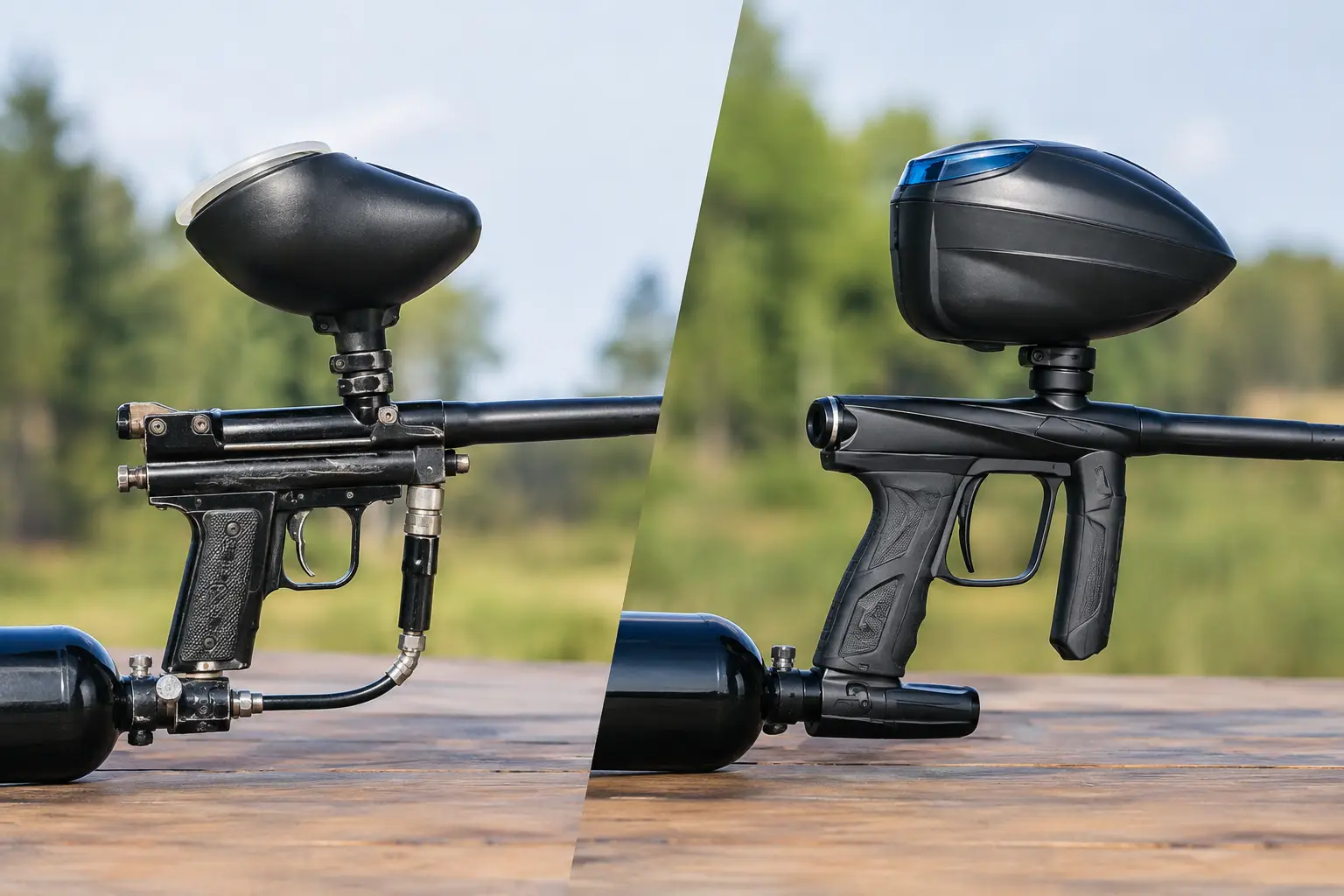
A marker that shoots flawlessly in the staging area but quits after a Florida rain shower, a dead battery, or a neglected o-ring is not helping your game. The mechanical versus electronic paintball markers decision is less about buying the “best” marker and more about choosing a setup that matches how you play, what your field allows, and how much maintenance you want to handle.
Both styles can be accurate, dependable, and a lot of fun. The right choice comes down to simplicity versus adjustability, not beginner gear versus serious gear. Plenty of experienced players trust mechanical markers, while plenty of first-time players benefit from a well-set-up electronic marker.
Mechanical Versus Electronic Paintball Markers: The Real Difference
A mechanical marker fires when you pull the trigger and mechanically release or redirect air through the firing system. It does not require a battery to cycle the marker. Most modern mechanical designs use a regulated HPA air system, and many deliver a smooth, consistent shot with far less kick than older blowback markers.
An electronic marker uses a battery-powered board and solenoid to control the firing cycle. The trigger activates a microswitch or optical sensor, and the board tells the solenoid when to move air through the marker. This lets the player set firing modes, rate of fire limits, dwell, debounce, and other functions depending on the model.
That extra control is the reason electronic markers can shoot faster and feel lighter at the trigger. It is also why they have more components that need proper setup, battery care, and occasional troubleshooting.
Why Players Choose Mechanical Markers
Mechanical markers are straightforward by design. There is no circuit board to program, no firing mode to accidentally set wrong, and no battery to check before loading the car for game day. For recreational players, woodsball players, and anyone who values a marker that is easy to understand, that simplicity matters.
A good mechanical marker is also an excellent platform for learning the fundamentals. You are more likely to focus on movement, communication, lane control, and making your shots count when you are not relying on a high rate of fire. Mechanical events and mech-only games are built around this style of play, but a mechanical setup is not limited to those formats.
Maintenance is usually more approachable, too. You still need to clean the marker, inspect o-rings, use the correct lubricant, and take care of your tank. But diagnosing a problem is often more direct. If a mechanical marker leaks or fails to cycle, the cause is commonly an o-ring, a worn seal, a dirty bolt area, or an air-system issue rather than an electronic setting.
Cost can be another advantage. Mechanical markers generally have a lower entry price, and they do not require replacement batteries or electronic upgrades. That does not mean every mechanical marker is cheap. Premium mechanical platforms can be highly refined, efficient, and upgradeable. It means your money can go toward the items that often make a bigger difference for new players: a quality mask, reliable HPA tank, paint, pod pack, and field fees.
The trade-off is speed. A mechanical trigger has more physical resistance and a longer pull than a tuned electronic trigger. Some mechanical markers can shoot quickly in capable hands, but they are not designed to maintain the same effortless volume of fire as an electronic setup. For many players, that is not a drawback. For a player who wants to compete in fast-paced speedball, it may be.
Why Players Choose Electronic Markers
Electronic markers give players more adjustment and a faster trigger response. With a properly configured board, an electronic marker can be set to meet a field’s rate-of-fire rules while delivering a very consistent firing rhythm. That can be useful in tournament-style paintball, where controlled lanes, snap shooting, and quick follow-up shots matter.
The trigger is a major part of the experience. Electronic triggers are often lighter, shorter, and easier to activate repeatedly than mechanical triggers. You do not need to fight the trigger to shoot quickly, which can reduce fatigue during long points and make the marker feel more responsive.
Most electronic markers also offer firing modes that may include semi-automatic, ramping, or capped settings. The key word is may. Field rules vary, and many fields require a specific rate-of-fire cap or semi-auto only. A faster marker does not override the rules. Before game day, confirm the field’s velocity limit, firing-mode policy, and rate-of-fire limit, then have your marker set accordingly.
Electronic markers can also be very gentle on paint. Many are designed with low-pressure operation, refined bolt systems, and eyes that prevent the marker from firing if a paintball is not seated correctly. That can be a real benefit when using fragile tournament paint or shooting in conditions where paint is more likely to break.
The trade-off is that electronics require attention. Bring a fresh battery, keep your marker dry, and learn the basics of its settings before you arrive at the field. A low battery can cause inconsistent cycling or a marker that will not fire. A dirty eye system can create problems that look more serious than they are. Incorrect dwell, debounce, or firing settings can cause poor performance or put the marker outside field rules.
Electronic markers are not unreliable by default. Quality models are built for paintball use. They simply ask more from the owner than a mechanical marker does.
Air Use, Paint Use, and the Cost of Playing
Do not assume a mechanical marker is always less efficient or that an electronic marker always uses more air. Efficiency depends on the specific marker, its regulator condition, barrel setup, paint match, operating pressure, and tune. A modern mechanical spool-valve platform can be very efficient, while an older electronic marker may use considerably more air per shot.
Electronic markers can encourage faster shooting, however, and that affects your day more than the marker’s air efficiency. More shots mean more paint, more hopper refills, and more trips to the air fill station. If you are trying to keep paint costs under control, a mechanical marker naturally encourages a more deliberate style of play.
That is not an argument against electronic markers. It is a reminder to budget for the way you want to play. A fast electronic setup needs a loader that can feed reliably at the marker’s intended rate of fire. A basic gravity hopper may work for casual semi-auto use, but it can struggle when an electronic marker is shooting quickly. Mechanical markers are generally less demanding on loaders, though a good powered loader still improves consistency.
Which Marker Fits Your Style?
Choose a mechanical marker if you want a dependable, uncomplicated setup for weekend rec play, woodsball, scenario games, or mechanical divisions. It is a strong fit if you want to spend more time playing and less time adjusting settings, or if you are building your first complete paintball kit on a sensible budget.
Choose an electronic marker if you enjoy speedball, want a light and responsive trigger, or need the consistency and controlled rate of fire that competitive play often demands. It also makes sense for players who are comfortable checking batteries, cleaning eyes, and following a manufacturer’s maintenance schedule.
If you are between the two, look at your local field and the players you expect to play with. A new player joining casual groups does not need an electronic marker to have a great day. A player moving toward tournament formats may outgrow a basic mechanical setup sooner. Neither path is wrong, and both can be upgraded over time.
Do Not Forget the Supporting Gear
Your marker is only one part of the setup. A properly fitting thermal paintball mask, a reliable HPA tank, quality paint, and a loader matched to your marker matter just as much. A poorly maintained tank regulator or damaged mask lens can ruin a day faster than choosing the wrong firing system.
Before buying, hold the marker if possible. Check the grip frame, balance, trigger feel, hose routing, and how easily you can access the bolt and battery. Ask what routine maintenance it needs and whether replacement parts are readily available. The marker that feels right in your hands and fits your actual game plan is usually the better purchase.
At Combat Zone Sports, we have helped Central Florida players sort through that decision since 2003, including the maintenance and repair questions that come after the sale. Bring in your current setup or describe where and how you play. A practical recommendation should leave room in your budget for the gear, air, paint, and game days that keep you in the sport.