
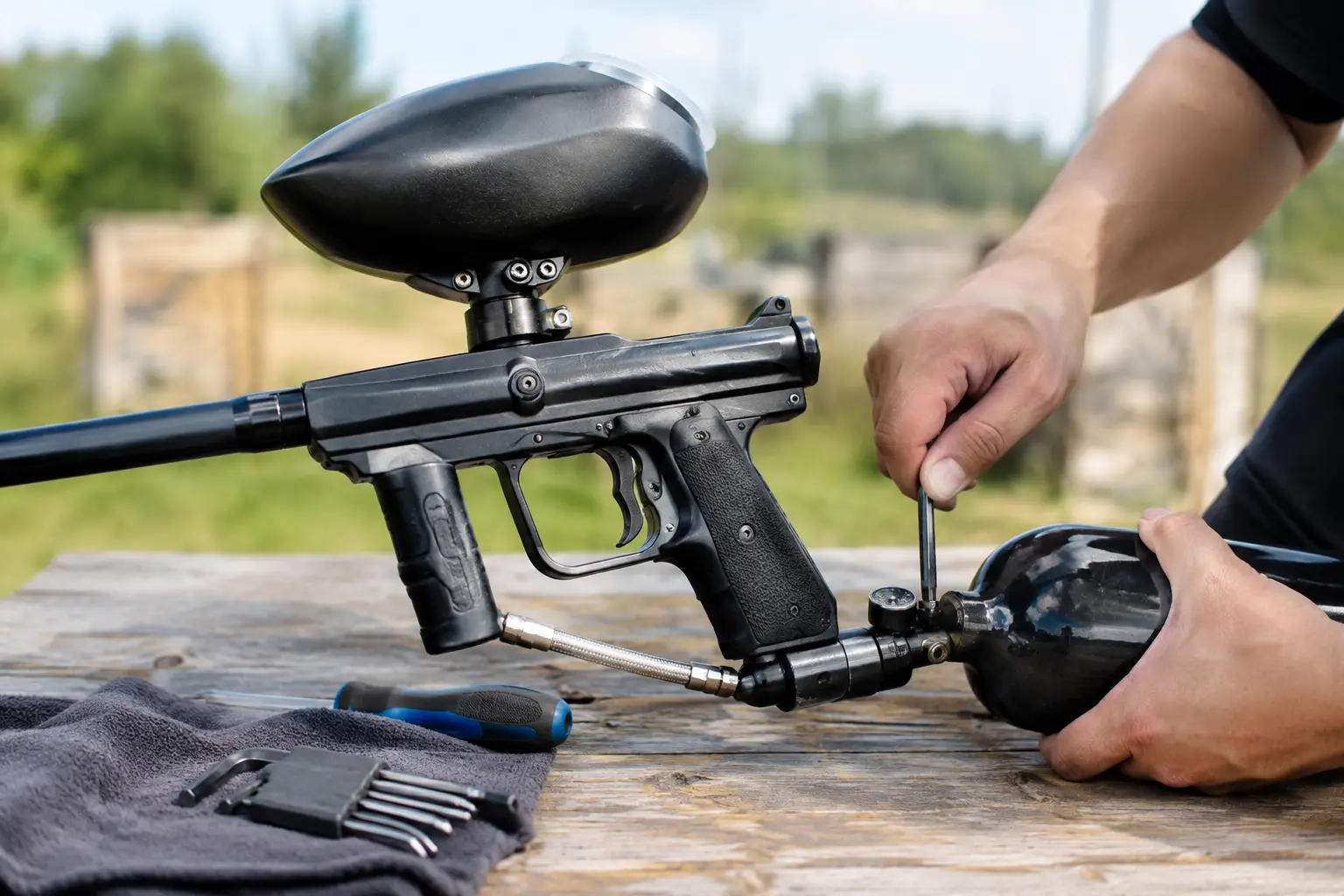
A marker that starts hissing while you are loading up for a game is more than annoying. It can drain a tank, ruin consistency, and turn a planned day of paintball into a bench-side repair session. The good news is that a paintball marker leaking air fix is usually straightforward once you identify exactly where the air is escaping. The mistake is treating every leak as the same problem and replacing parts at random.
Start with a clean, unloaded marker and a little patience. Most air leaks come down to a worn O-ring, a dirty sealing surface, a loose fitting, or a component that needs more than a quick field repair. Finding the leak first saves money and prevents damage to threads, valves, and internal parts.
Safety First: Degas Before You Work
Remove paintballs and the barrel, engage the safety, and point the marker in a safe direction. If the marker is already aired up, keep hands away from the front of the barrel and do not begin disassembly while it is pressurized.
For HPA systems, shut off the tank’s on/off if your setup has one, then dry-fire in a safe direction until the marker is fully degassed. With CO2, carefully remove the tank only after the marker is empty of pressure. CO2 can get extremely cold during removal, so gloves are smart if the tank is frosted or actively venting.
Never use petroleum-based oils, household lubricants, or random sealants inside a paintball marker. Use paintball-safe grease or oil specified for your marker. The wrong lubricant can swell seals, attract dirt, or damage certain materials.
Find the Hiss Before Buying Parts
Your ears can usually narrow the problem down quickly. Air escaping from the tank connection, grip frame, barrel, bolt area, or back cap points to different seals and systems.
If the leak is subtle, add a small amount of soapy water to the suspected external area. Bubbles will reveal a leak around fittings, threads, or an accessible O-ring. Keep water out of the marker’s electronics, eyes, and internal air passages. Wipe the marker dry after testing.
A leak can also change after you pull the trigger. That detail matters. A marker that leaks constantly at rest has a different likely cause than one that only hisses down the barrel after firing.
Leak at the Tank or ASA
If air is escaping where the tank screws into the marker, inspect the tank’s valve O-ring first. This is the small O-ring at the top of the tank valve that seals against the ASA. It is one of the most common and least expensive fixes in paintball.
Replace a nicked, flattened, brittle, or missing tank O-ring with the correct size. Add only a light film of paintball-safe lubricant if your marker manufacturer recommends it. Do not over-lubricate the tank threads.
If a fresh tank O-ring does not solve the issue, inspect the ASA itself. A worn ASA pin, damaged internal seal, or stripped threads may be the problem. Stop forcing the tank if it does not thread in smoothly. Cross-threading an ASA or tank valve turns a small repair into a costly replacement.
Leak From the Grip Frame or Bottom of the Marker
A leak around the grip frame often points to the regulator, air transfer passage, hose fitting, or an internal grip-frame seal. On mechanical markers, this could involve the regulator seat or valve area. On electronic markers, it may be a damaged fitting or a seal between the frame and body.
Check any external macroline or hose first. Look for cracks, loose fittings, or a hose that has been cut unevenly. A line that wiggles in a push fitting may need to be trimmed squarely or replaced. Do not yank on a pressurized hose to test it.
If the leak is clearly inside the frame, it is usually time to consult the marker manual or bring it to a qualified paintball technician. Electronics, solenoids, and tiny seals are easy to damage when you are working without the proper diagram or tools.
Leak Down the Barrel
Air coming out of the barrel usually means the marker’s valve is not sealing fully. On many spool-valve markers, the likely causes are worn bolt O-rings, dry seals, debris on the bolt, or an issue with the valve can or engine assembly. On poppet-style markers, the cup seal, valve pin, or valve spring may need attention.
Remove the bolt or engine following the manufacturer’s instructions. Clean off old paint, dirt, and excess grease. Inspect each O-ring closely under good light. A damaged O-ring may have a cut, flat spot, swelling, or rough edge, but even a seal that looks fine can leak if it has hardened or lost its fit.
Replace only the O-rings called out in the manual, then apply the correct amount of lubricant. Too little lubrication can cause friction and sealing problems. Too much can migrate into areas where it does not belong and collect dirt. Reassemble carefully, air up, and test again.
If the marker still leaks down the barrel after a proper O-ring service, do not keep increasing pressure or forcing parts together. A worn valve seat or damaged internal surface may need professional inspection.
Leak From the Back Cap, Rear of the Body, or Bolt Area
A rear leak is often related to a back-cap O-ring, rear bolt seal, velocity adjuster, or a seal in the marker’s drive train. This is common on older mechanical designs and can also show up when a bolt has been installed incorrectly after cleaning.
Check that the back cap is threaded correctly and fully seated. Remove it only after degassing, then inspect its O-ring and the nearby sealing surface. Dirt, thread damage, and a pinched O-ring can all create a steady hiss.
On markers with a velocity adjuster at the rear, do not crank the adjuster aggressively to stop a leak. Velocity adjustment is not a repair method. If turning it changes the leak, that is useful diagnostic information, but the underlying seal or valve component still needs attention.
A Paintball Marker Leaking Air Fix That Actually Lasts
The best repair is not always the fastest one. Replacing one visibly damaged O-ring may get you through a game, but a marker with several dry, aging seals may be ready for a full service. This is especially true if it has sat in a gear bag for months, has seen frequent use, or was purchased secondhand without a maintenance history.
Use marker-specific O-rings when possible. Paintball markers use different seal sizes and materials, and a generic hardware-store O-ring may fit loosely, bind during cycling, or fail quickly under pressure. Keep a small rebuild kit and approved lubricant in your gear bag, especially if you play regularly.
For CO2 users, expect more attention to seals during temperature swings. Liquid CO2 and rapid firing can chill components enough to make marginal seals leak temporarily. HPA is generally more consistent, but it does not eliminate leaks caused by worn O-rings or neglected maintenance.
When It Is Time for a Pro-Shop Repair
Bring the marker in when the leak involves a regulator, solenoid, valve seat, damaged threads, stripped screws, or a problem that returns immediately after correct O-ring replacement. The same goes for any marker that suddenly vents large amounts of air or behaves unpredictably after a repair attempt.
A good technician can pressure-test the marker, identify the actual source, and prevent the common cycle of buying parts that were never needed. For Central Florida players, Combat Zone Sports can inspect paintball markers, handle repairs and upgrades, and help you choose the right replacement seals or air-system parts without pushing unnecessary work.
Before your next game, air up your marker at home or at the shop and listen for ten seconds. That small habit catches leaks before they empty a tank in the staging area, and it gives you time to fix the real problem instead of missing the first match.