
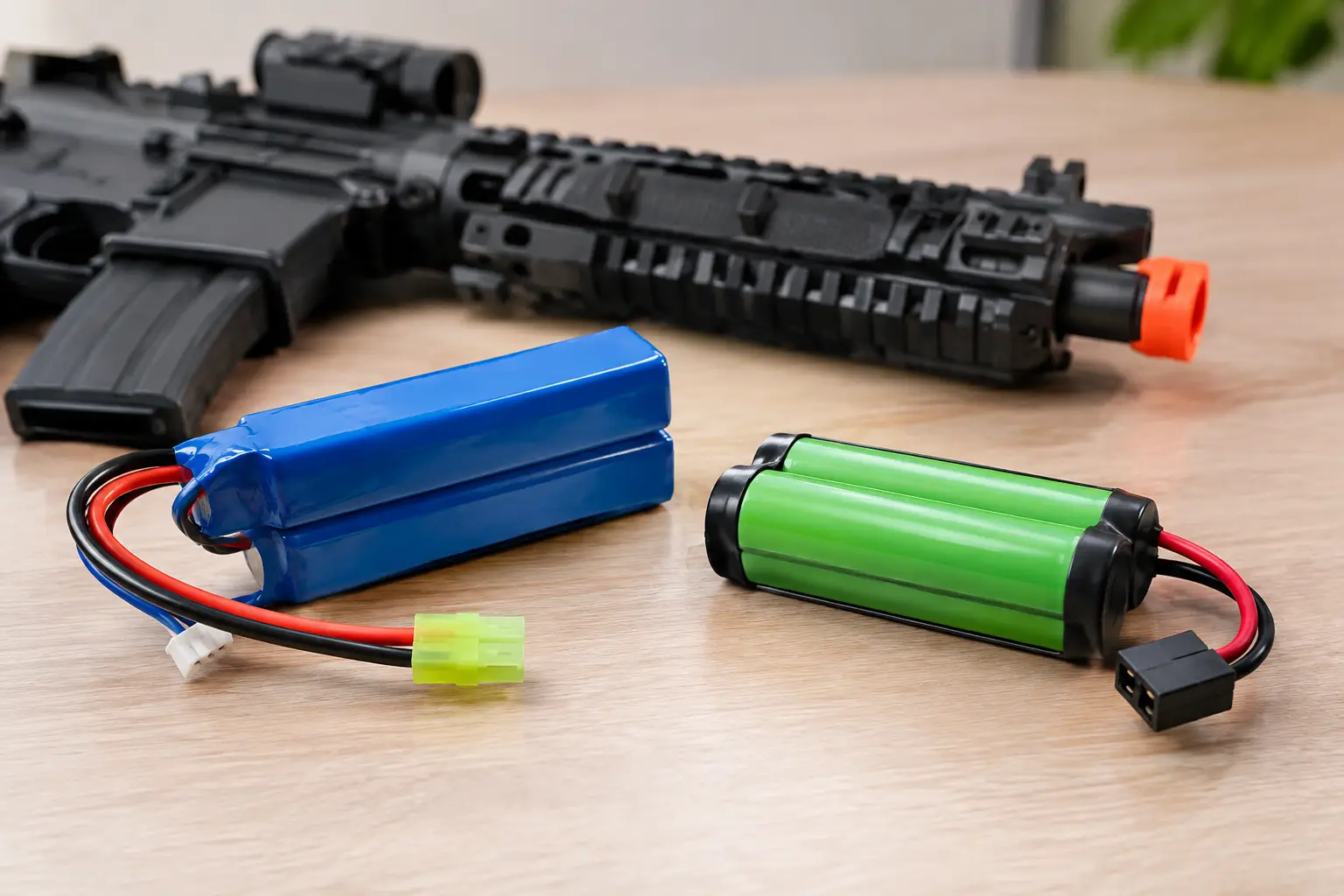
Your AEG can feel completely different with the same gun, same BBs, and a different battery. That is why airsoft LiPo versus NiMH batteries is not just a specs debate. The right choice affects trigger response, rate of fire, run time, charging routine, and whether your battery fits the stock or handguard in the first place.
For a first airsoft gun, NiMH is often the easier starting point. For players who want a sharper, more responsive setup, LiPo is usually the move. Neither battery is automatically right for every player or every replica. The best answer depends on your gun, your electronics, your play style, and how much battery care you are willing to take on.
Airsoft LiPo Versus NiMH Batteries: The Real Difference
A nickel-metal hydride battery, usually called NiMH, is the traditional rechargeable pack included with many entry-level AEGs. It is comparatively forgiving, affordable, and familiar. Most are available in common voltages such as 8.4V and 9.6V.
A lithium polymer battery, or LiPo, delivers power more efficiently and maintains stronger voltage under load. In practical terms, that usually means a quicker trigger pull, more consistent cycling, and a better feeling gun. Common airsoft LiPo options are 7.4V two-cell packs and 11.1V three-cell packs.
The voltage number alone does not tell the whole story. A quality 7.4V LiPo can make an entry-level AEG feel more lively than a 9.6V NiMH pack because LiPo chemistry handles demand differently. It can send current to the motor more readily, especially when the gun is working against a heavier spring or a fast trigger pull.
That performance comes with responsibility. LiPos must be charged with a compatible balance charger, inspected for damage, and stored properly. NiMH packs ask much less of the owner, which still matters when you are getting ready for a weekend game with friends.
Why Many Players Start With NiMH
NiMH batteries are a sensible choice for beginners, rental-style backup guns, younger players under supervision, and anyone who wants a straightforward battery routine. They are less sensitive to charging mistakes than LiPos and do not require a storage-charge setting between games.
They also tend to be a good match for stock AEGs with basic wiring and no electronic trigger unit. If your gun came with an 8.4V or 9.6V NiMH pack, staying with that style battery is the safe, simple route until you understand what your replica can handle.
The downside is performance. NiMH packs are physically larger for the amount of energy they hold, and their output drops more noticeably as they discharge. You may hear the motor slow down late in the day. Trigger response can feel softer, particularly in cold weather or on guns with upgraded springs.
That does not make NiMH obsolete. A properly charged 9.6V NiMH battery can run a basic AEG reliably all day for many recreational players. If your priority is minimizing complexity, it remains a solid option. It is better to run a battery you understand and maintain than to buy a high-output pack you charge incorrectly.
What LiPo Changes on the Field
LiPo batteries are popular because players feel the improvement immediately. Semi-auto shots cycle more crisply, follow-up shots come faster, and the motor does not fade as quickly through the charge. For indoor play, quick target transitions, or any player who uses semi-auto heavily, that sharper response is a real advantage.
LiPos are also compact. A slim stick pack can fit into buffer tubes, crane stocks, and tight handguards where a bulky NiMH pack will not fit. This gives you more options when choosing a replica or building a cleaner-looking setup.
A 7.4V LiPo is the usual recommendation for a stock AEG that is LiPo-ready or has been checked by a technician. It offers a meaningful improvement without putting the same stress on the gearbox, trigger contacts, and motor as an 11.1V pack.
An 11.1V LiPo is not simply the better battery. It can increase cycling speed and trigger response, but it also increases electrical and mechanical stress. On a gun with basic mechanical trigger contacts, it may cause arcing and faster contact wear. On an AEG with a quality MOSFET, electronic trigger unit, and internals built for the demand, an 11.1V can be a great performance choice. On a stock beginner gun, it can be an expensive way to create a repair bill.
Check Your Gun Before Choosing Voltage
Before buying any battery, check four things: the battery compartment dimensions, the connector type, the gun’s recommended voltage, and whether it has a MOSFET or electronic trigger unit.
Physical fit is often the first problem. A battery may have the right voltage and connector but still be too long, too wide, or too thick for your stock tube or handguard. Measure the available space instead of guessing. Folding and crane-stock battery compartments can be especially restrictive.
Connector type matters as well. Many older AEGs use small Tamiya connectors. Deans-style connectors are common on upgraded builds because they offer a more secure connection and lower resistance. Do not force mismatched connectors or rely on a loose adapter as a permanent solution. A properly installed connector is safer and more reliable.
Next, follow the manufacturer guidance when it is available. Some modern replicas are designed around LiPo use. Others were built with NiMH in mind. If there is no clear recommendation, start conservatively with a 7.4V LiPo or a quality 9.6V NiMH, depending on the gun’s condition and electronics.
A MOSFET is helpful, but it is not a magic approval stamp for every battery. It protects or replaces the mechanical trigger circuit in many setups, yet gearbox shimming, motor condition, spring strength, and overall build quality still determine what the gun can handle.
Capacity and C Rating Without the Guesswork
Battery capacity is shown in milliamp-hours, or mAh. Higher mAh generally means more shots per charge, but a larger-capacity pack is usually physically larger. A 1,200 mAh stick battery may fit where a 2,000 mAh pack cannot.
The C rating refers to discharge capability. In plain language, it indicates how quickly the battery can provide current. Most players do not need to chase the biggest number on the label. A reputable 7.4V LiPo with an appropriate capacity and a moderate-to-high discharge rating is enough for most stock and lightly upgraded AEGs.
Avoid treating a huge C rating as a performance upgrade by itself. Your gun only draws the current it demands. What matters more is buying a quality pack that fits, using the correct voltage, and keeping the wiring and connectors in good condition.
LiPo Care Is Part of the Purchase
If you choose LiPo, plan on buying or using a proper balance charger. The balance lead allows the charger to monitor and equalize individual cells, which is essential for safe charging and battery life.
Charge LiPos on a nonflammable surface, inside a LiPo-safe charging bag or other appropriate fire-resistant container, and never leave them unattended. Do not charge a swollen, punctured, overheated, or damaged pack. If a battery looks puffy or its wiring is compromised, stop using it.
You also need to avoid over-discharging a LiPo. Many AEG electronic trigger units include low-voltage protection, but not all guns do. If your gun suddenly slows down, stops cycling normally, or gives a low-battery warning, disconnect the battery rather than continuing to pull the trigger. A LiPo alarm can be a useful safeguard on setups without built-in protection.
For storage longer than a few days, use your charger’s storage-charge mode rather than leaving a LiPo fully charged or fully drained. Florida heat is hard on all batteries, so do not leave packs in a hot car, direct sun, or a sealed gear bag after a game.
NiMH packs still deserve basic care. Use a charger intended for NiMH chemistry, disconnect the pack when charging is complete, and let it cool before recharging after heavy use. They are more forgiving, not indestructible.
Which Battery Should You Buy?
Choose a NiMH battery if you are new, your AEG is completely stock, you want the simplest charging routine, or you need a dependable backup pack for a casual day of play. A 9.6V NiMH is often a practical upgrade over an 8.4V pack when the gun allows it.
Choose a 7.4V LiPo if your gun is compatible and you want better trigger response, smaller battery options, and more consistent performance. It is the best all-around LiPo choice for many players.
Consider an 11.1V LiPo only when the gun’s electronics and internal build support it. This is where honest advice matters more than a bigger number on the package. More speed is not useful if it shortens the life of your trigger contacts, strips a weak gearset, or causes inconsistent feeding.
If you are unsure what fits your AEG or what voltage it can safely run, bring the gun and its current battery to Combat Zone Sports. Checking the compartment, connector, and setup before you buy is far cheaper than forcing a pack into a stock or troubleshooting an avoidable electrical issue. The right battery should make your next game more dependable, not turn the night before it into a charging emergency.