
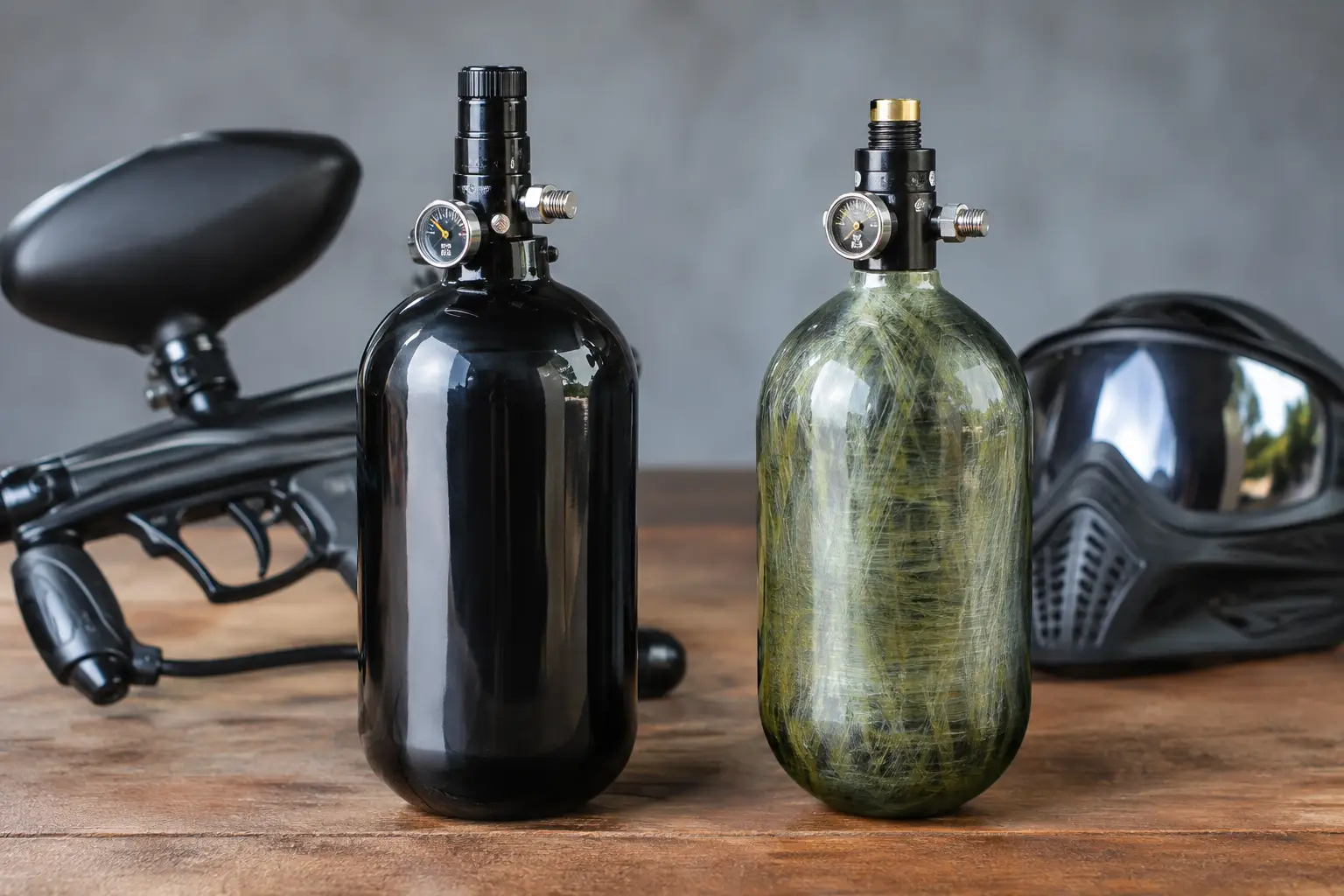
Your marker is only as dependable as the air system feeding it. A player can spend good money on a marker, barrel, hopper, and paint, then lose consistency because the tank does not match the setup or the conditions. When comparing HPA versus CO2 paintball tanks, the right answer is not always the cheapest tank on the shelf. It depends on your marker, where you play, how often you play, and whether you want a simple recreational setup or a platform you can build on.
For most current paintball markers, HPA is the practical long-term choice. CO2 still has a place, especially with certain mechanical markers and budget-minded setups, but it comes with limitations that matter even more in Central Florida heat.
HPA Versus CO2 Paintball Tanks: The Main Difference
HPA means high-pressure air. These tanks are filled with compressed air, usually regular breathable air rather than a special fuel. The tank regulator reduces the stored pressure to a usable output pressure for the marker. Because compressed air remains a gas through normal paintball use, it delivers a more stable pressure from shot to shot.
CO2 tanks hold liquid carbon dioxide under pressure. As you fire, liquid CO2 changes into gas to power the marker. That phase change is why CO2 can work well in the right setup, but it is also why temperature, firing speed, and tank position affect performance more than they do with HPA.
The simplest way to think about it: HPA is more consistent and more compatible with modern equipment. CO2 is often less expensive to get into, but it can be less predictable and requires a marker designed to handle it.
Why Most Modern Markers Prefer HPA
Electronic and electropneumatic paintball markers generally need HPA. Their internal solenoids and regulators are designed around stable air pressure. Introducing liquid CO2 into a marker that is not CO2-compatible can cause velocity swings, damaged seals, regulator problems, and expensive repair work.
Even many mechanical markers perform better on HPA. A stable air source helps maintain more consistent velocity, which improves accuracy in the practical sense: your paint is leaving the barrel at a more repeatable speed. It also makes it easier to tune a marker and identify whether a performance issue comes from the gun, paint, barrel, or air system.
HPA is especially useful for players running an electronic hopper, shooting quickly, or playing longer days. A fast string of shots can cool a CO2 tank and reduce its pressure. HPA does not suffer from that same cooldown effect.
This does not mean every mechanical marker requires HPA. Plenty of older mechanical markers, blowbacks, and entry-level CO2-capable setups can run reliably on CO2 when they are maintained correctly. The key is checking the marker manufacturer’s air-source recommendation before buying a tank.
HPA consistency on the field
HPA pressure drops gradually as the tank empties, but the regulator is designed to provide a stable output until the tank is nearing empty. That gives players more consistent shots through most of the fill. It also helps when chronoing before a game, since the marker is less likely to change dramatically after a few strings of fire.
For a beginner, that consistency means less guessing. For an experienced player, it means a more dependable baseline for tuning and upgrades.
Where CO2 Still Makes Sense
CO2 is not obsolete. It can be a reasonable choice for a player with a CO2-ready mechanical marker who plays occasionally and has easy access to CO2 fills. Smaller CO2 tanks are compact, widely familiar, and can keep the initial cost down.
CO2 also stores a lot of usable energy in a small tank. Depending on the tank size and marker efficiency, it can provide a solid shot count for a casual day. A 20-ounce CO2 tank remains common for mechanical setups because it offers more capacity than the small 12-ounce option without becoming overly bulky.
The trade-off is temperature sensitivity. On a hot Florida day, CO2 pressure can rise substantially. If the tank gets hot in a vehicle, direct sun, or enclosed gear bag, that pressure can become a safety concern. On the other hand, repeated firing cools the tank and can cause pressure to drop. You may see velocity inconsistency, especially if you fire quickly or use a setup that allows liquid CO2 to reach the marker.
CO2 works best when the marker was built for it, the player understands its behavior, and the tank is filled and handled correctly. It is not the right shortcut for making an HPA-only marker cheaper to operate.
Cost, Fill Availability, and Shot Count
The upfront price of an HPA setup is often higher. A basic aluminum HPA tank is usually the entry point, while lighter carbon-fiber tanks cost more but hold more air at higher pressures. Common HPA sizes include 48/3000, 48/4500, and 68/4500. The first number is the tank volume in cubic inches, while the second is the maximum fill pressure.
A 48/3000 aluminum tank is a dependable starter choice. It is heavier than carbon fiber, but it is durable, straightforward, and appropriate for many beginner mechanical and electronic marker setups. A 68/4500 carbon-fiber tank is a popular upgrade because it offers a higher shot count while keeping weight manageable.
CO2 tanks generally cost less initially, and CO2 fills may be inexpensive where available. However, fill availability should be part of the decision. Many paintball fields provide HPA fills as part of admission or offer convenient all-day air. CO2 availability varies more by field and retail location. Before committing to either system, confirm what your regular field actually fills.
Shot count is never a single guaranteed number. It changes with marker efficiency, tank pressure, weather, paint quality, velocity, and how aggressively you shoot. HPA tanks are easier to compare by size and pressure rating, while CO2 can deliver good shot counts but is more affected by conditions.
Tank Size and Balance Matter More Than Players Expect
The biggest tank is not automatically the best tank. A larger tank gives more shots, but it also changes how the marker shoulders and balances. A smaller player may find a long 68-cubic-inch tank uncomfortable, while a taller player may prefer its added length at the shoulder.
Try shouldering the marker before deciding if you can. The tank should let you keep a comfortable cheek position on the marker without forcing your wrist or shoulder into an awkward angle. This matters on game day far more than saving a few ounces or chasing the highest possible capacity.
For rec-ball players, a 48/3000 or 48/4500 HPA tank can be a sensible starting point. Players who want to play longer between fills often move to a 68/4500. If you use a stock-class or compact mechanical setup, a smaller tank may fit the purpose better.
Do not overlook regulator output
HPA tanks use regulators that commonly provide a higher output pressure around 800 psi or a lower output in the 450-550 psi range. Many markers work with either, but some have specific requirements. Certain mechanical markers, electronic markers, and aftermarket setups may benefit from or require a particular output range.
Do not choose a tank based only on the bottle size. Confirm the marker’s requirements, especially if you are buying a used marker, installing an upgrade, or working with a specialized mechanical build. An honest pro-shop recommendation can prevent a frustrating compatibility problem.
Safety and Maintenance for Both Tank Types
Both HPA and CO2 tanks are high-pressure cylinders. Treat them with the same respect you would give any pressurized equipment. Do not leave tanks in a hot car, strike the valve against hard surfaces, modify the valve or regulator yourself, or use a tank with visible damage to the neck, threads, or bottle.
Check the hydrostatic test date stamped on the tank. Paintball cylinders require periodic testing, commonly every five years in the United States. Carbon-fiber HPA tanks also have a finite service life set by the manufacturer, often 15 years from the manufacture date. A tank can look clean and still be out of date, so always check before buying used.
Keep the tank threads clean, use the correct tank o-ring, and inspect the regulator for leaks. If a tank leaks from the valve or the marker behaves inconsistently, stop forcing it. A worn o-ring is a simple fix; a damaged regulator or a marker issue needs proper diagnosis.
Which Tank Should You Buy?
Choose HPA if you own a modern electronic marker, want the most consistent performance, expect to upgrade later, or regularly play at fields with compressed-air fills. It is the clear choice for most players buying their first serious paintball setup.
Choose CO2 only if your marker is specifically CO2-compatible, you understand the temperature and rapid-fire limitations, and CO2 fills are convenient where you play. It can still serve a casual mechanical player well, but it is not the universal option it once was.
If you are unsure, bring your marker into Combat Zone Sports before buying a tank. Matching the air system to your marker, playing style, and local fill options is a small decision that can save you from inconsistent shots, damaged parts, and buying the same gear twice. The best tank is the one that keeps your marker reliable and lets you focus on the next game.