
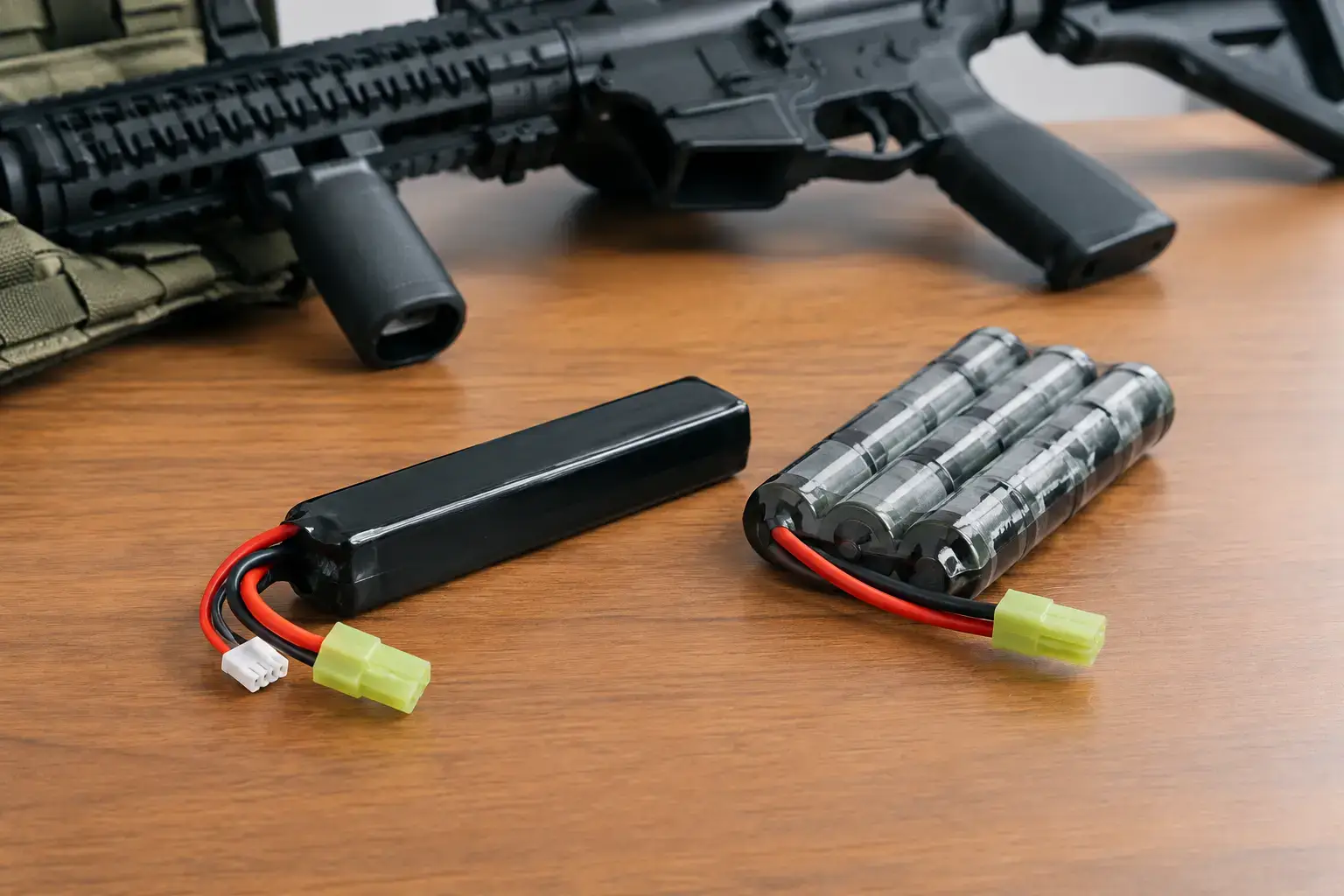
Your battery can make a dependable AEG feel sharp and responsive, or make a great day of airsoft frustrating before lunch. The LiPo versus NiMH decision is not about picking the newest battery by default. It is about matching voltage, size, connector, charging habits, and your rifle’s internals to the way you actually play.
For a first AEG, a quality NiMH battery is often the easiest place to start. For players who want faster trigger response, a more compact battery fit, or stronger performance in a tuned setup, LiPo is usually the better tool. Neither is automatically right for every gun or every player.
LiPo versus NiMH: The Real Differences
NiMH means nickel-metal hydride. These packs have been common in airsoft for years because they are straightforward, durable, and forgiving. They generally come as stick, nunchuck, crane-stock, or brick-style packs and are commonly available in 8.4V and 9.6V configurations.
LiPo means lithium polymer. A LiPo pack delivers power more efficiently and holds its voltage better under load. In practical airsoft terms, that often means a snappier trigger, faster cycling, and more consistent performance as the battery discharges. Common airsoft LiPo options are 7.4V two-cell packs and 11.1V three-cell packs.
Voltage is only one part of the story. Battery capacity, measured in milliamp-hours or mAh, affects expected run time. The discharge rating, often shown as a C rating, indicates how much current a pack can safely provide. Physical dimensions and plug type determine whether the battery will fit and connect to your AEG at all.
A battery with impressive numbers on the label is not a good buy if it will not fit in the stock, buffer tube, handguard, or battery compartment. Before purchasing, check the available space and the connector on your gun. Small-stick batteries are often needed for tight storage areas, while crane stocks may accept nunchuck packs. Do not force a pack into place or pinch its wiring under a stock or receiver.
Why NiMH Still Makes Sense
NiMH remains a smart choice for beginners, rental-style setups, younger players under adult supervision, and anyone who wants simple battery ownership. It does not require balance charging or storage-voltage management. A compatible smart charger with a NiMH setting makes the process fairly simple.
An 8.4V NiMH pack is a conservative option for many stock AEGs. A 9.6V NiMH can offer a noticeable improvement in trigger response and rate of fire while still being familiar territory for many standard builds. If your AEG shipped with a NiMH battery recommendation, following that recommendation is a safe starting point.
There are trade-offs. NiMH packs are bulkier for the usable capacity they provide, and their output can feel less lively as the pack drains. They can also be harder to fit in compact replicas. A player running a rear-wired rifle with limited stock space may find that a properly sized LiPo solves a fitment problem that a larger NiMH pack cannot.
NiMH batteries still need proper care. Use the correct charger setting, let a hot battery cool before charging, and stop using a pack that is leaking, badly swollen, or has damaged wiring. Never charge any airsoft battery unattended.
Why Players Move to LiPo
LiPo is the common next step for players who want their AEG to react faster without immediately opening the gearbox. A 7.4V LiPo is often an excellent upgrade for a healthy stock rifle, particularly one with a MOSFET or electronic trigger unit. It provides efficient, consistent power in a compact package without the aggressive demand of an 11.1V pack.
An 11.1V LiPo can deliver a major jump in trigger response and cyclic rate. That can be exactly what a performance-minded player wants, but it also puts more stress on the electrical system and moving parts. On a rifle with weak contacts, worn wiring, poor shimming, or a basic mechanical trigger setup, an 11.1V battery can expose problems quickly. It may cause arcing at trigger contacts, excessive wear, feeding issues at high speed, or premature gearbox trouble.
That does not mean 11.1V is bad. It means the rifle needs to be ready for it. A properly built AEG with suitable wiring, a MOSFET, and internals set up for its intended rate of fire can run an 11.1V LiPo very well. If you are unsure, ask before changing voltage. A battery is less expensive than a repair, but the wrong battery choice can create one.
LiPo packs require more disciplined handling than NiMH. Charge them only with a LiPo-capable balance charger, using the correct cell count and charge rate. Balance charging keeps the individual cells at similar voltage, which helps pack life and safety. Charge on a nonflammable surface, preferably in a LiPo charging bag or other appropriate fire-resistant container, and stay nearby while charging.
Do not store a LiPo fully charged for weeks after a game. Use the storage mode on a proper charger when the pack will sit for more than a short period. Do not run a LiPo until the gun slows down or stops cycling. Over-discharging can permanently damage the cells. A low-voltage alarm, a MOSFET with low-voltage cutoff, or a battery checker is inexpensive insurance.
Choosing the Right Battery for Your AEG
Start with the gun, not the battery label. Look at the manufacturer recommendation, the battery compartment, connector type, and whether the rifle has a MOSFET. Then consider your game-day needs.
If you have a stock beginner AEG and want easy operation, an 8.4V or 9.6V NiMH battery can be a practical fit. If you want better response but do not plan a major build, a quality 7.4V LiPo is often the sweet spot, assuming your gun is compatible. For upgraded rifles, high-speed setups, and electronic trigger units, 11.1V LiPo may be appropriate when the build and field rules support it.
Do not confuse battery voltage with muzzle velocity. A higher-voltage battery does not meaningfully raise FPS. It changes how quickly the motor cycles the gearbox, which affects trigger response and rate of fire. Chronograph rules still apply, and a rifle that shoots too fast mechanically may create reliability or field-compliance issues even if its FPS is legal.
Capacity deserves a realistic look as well. A 1,200 mAh pack may be enough for a light day, while a 1,600 mAh or 2,000 mAh pack can provide more room for longer events. Actual run time depends on your motor, spring, trigger use, temperature, firing style, and how much semi-auto versus full-auto you shoot. Carrying a correctly stored backup is often more useful than trying to squeeze an oversized pack into a tight compartment.
Connectors Matter More Than They Look
Many older AEGs use small Tamiya connectors. Deans or T-plug connectors offer a more secure connection and lower electrical resistance, which can improve efficiency in higher-demand setups. But changing connectors should be done correctly, with solid soldering and consistent polarity. A reversed connector can damage electronics immediately.
Avoid using cheap adapter stacks as a permanent solution. Every extra connection adds resistance, bulk, and another potential failure point. If your rifle is being upgraded or rewired, it is a good time to choose a connector standard that matches your batteries and chargers.
Common Battery Mistakes to Avoid
The most common mistake is buying by voltage alone. A player hears that 11.1V is faster, installs one in a stock AEG with no protection, and then wonders why the trigger contacts or gearbox need attention. Faster is only useful when the rest of the system can support it.
Another mistake is treating a LiPo like a NiMH pack. Do not use a basic wall charger, guess at the cell count, leave it charging overnight, or toss a damaged pack back into your gear bag. A swollen, punctured, overheated, or water-damaged LiPo should be removed from service and disposed of through an appropriate battery-recycling process.
Finally, do not overlook installation. Check that wires are not crushed when collapsing a stock or closing a handguard. Make sure the connector is fully seated, and inspect leads after hard use. Florida heat is hard on gear left in a vehicle, so keep batteries out of direct sun and never leave them in a hot car for extended periods.
Get a Battery Recommendation That Fits
The best choice is usually simpler than the online arguments make it sound. A dependable stock rifle, a first-time player, and a casual weekend schedule often point toward NiMH or a mild 7.4V LiPo. A tuned AEG with a MOSFET, limited battery space, and a player chasing quick semi-auto response points toward LiPo.
Bring your AEG to Combat Zone Sports if you want a fitment check before buying. Matching the battery to the gun, charger, connector, and your plans for future upgrades keeps your money focused on better game days instead of avoidable repairs. Choose the pack your rifle can use safely, learn the charging routine, and you will spend more time on the field and less time troubleshooting at the staging area.