
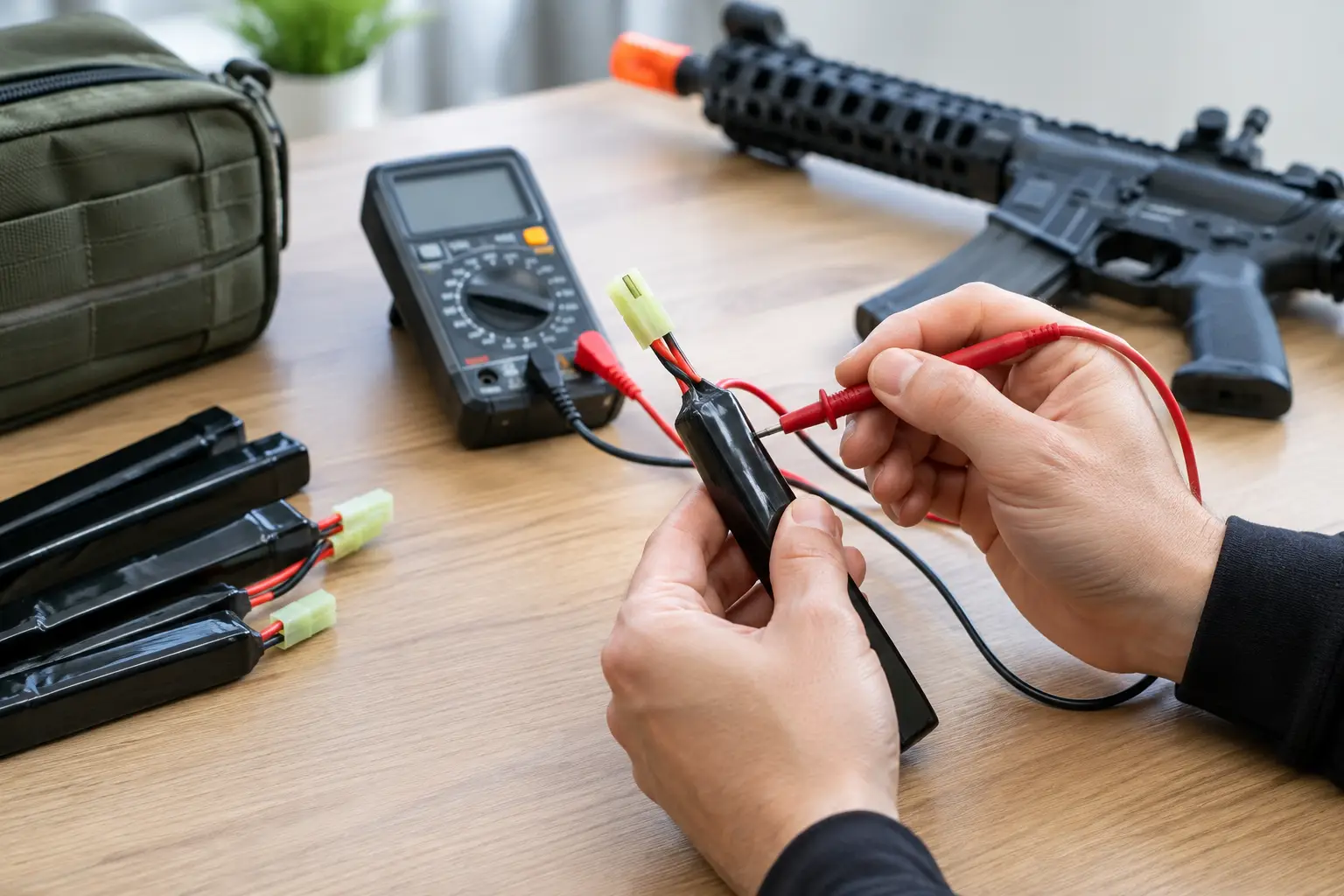
A dead AEG in the staging area is frustrating. A swollen LiPo or a battery that gets hot while charging is a bigger problem. Knowing how to test airsoft battery voltage and condition before you load magazines gives you time to fix the issue at home instead of losing a game day.
The good news is that most battery checks are quick. You do not need a full electronics bench, but you do need the right charging equipment, a basic multimeter, and the habit of inspecting your battery before and after use.
Start With a Physical Inspection
Before checking numbers, look at the battery itself. Disconnect it from the replica and remove it from the stock, handguard, or battery compartment. Check the wire insulation, connector, shrink wrap, and balance plug if it has one.
A battery should be retired from use if it is swollen, punctured, leaking, badly crushed, smells chemical or sweet, or has exposed wire. Do not try to charge a damaged lithium battery just to see whether it still works. Put it in a fire-resistant location away from combustible material and ask a knowledgeable shop how to dispose of it properly.
Also inspect the gun-side connector. A loose T-plug, burned mini-Tamiya connector, bent pin, or damaged fuse can cause the same sluggish response people often blame on a bad battery. If the battery looks fine but your AEG will not fire, the wiring and connector deserve just as much attention.
Know Which Airsoft Battery You Have
Your expected voltage depends on the battery chemistry and cell count. The label usually gives you the answer. Common AEG batteries include nickel-metal hydride, or NiMH, lithium polymer, or LiPo, and lithium-ion, often called Li-ion.
A typical NiMH pack may be 8.4V or 9.6V. A two-cell LiPo or Li-ion pack is normally labeled 7.4V, while a three-cell pack is 11.1V. Those labels are nominal voltage, not the voltage you will always read on a meter.
A fully charged 7.4V LiPo should read about 8.4V total because each cell reaches 4.2V. A fully charged 11.1V pack should read about 12.6V. A NiMH pack will also read higher than its label immediately after charging, then settle down after it rests.
Do not assume an 11.1V battery is automatically a better upgrade than a 7.4V pack. It can deliver faster trigger response and rate of fire, but it also puts more stress on the gearbox, motor, trigger contacts, and electronics. Whether it is appropriate depends on the replica’s internals and whether it has a MOSFET rated for that setup.
How to Test Airsoft Battery Voltage With a Multimeter
A basic digital multimeter is the simplest way to check overall battery voltage. Set it to DC voltage. Choose a range higher than the voltage you expect to measure – 20V DC works for most airsoft packs.
Touch the red probe to the positive terminal and the black probe to the negative terminal on the battery connector. On a Deans or T-plug, be careful not to let the probes touch each other while they contact the terminals. That can create a short. For mini-Tamiya connectors, take your time and make sure the probes contact the metal terminals, not just the plastic housing.
For a LiPo, compare the reading with the battery’s cell count. A healthy two-cell pack might read roughly 7.4V to 8.4V depending on its state of charge. A three-cell pack might read around 11.1V to 12.6V.
Voltage alone does not tell the whole story. A battery can show normal voltage with no load, then sag badly when the motor demands current. Still, a multimeter check catches obvious problems, such as a pack that was left discharged for too long or one that never reached a full charge.
If a LiPo reads below about 3.2V per cell at rest, stop using it until you can evaluate it carefully. Below 3.0V per cell is a serious warning sign. Some smart chargers may refuse to charge a deeply discharged pack, and forcing the issue can be unsafe. For long-term storage, lithium batteries are happiest around 3.7V to 3.85V per cell, not fully charged and not empty.
Check Individual Cells on LiPo Batteries
The balance connector on a LiPo provides the best quick check of battery health. Use a smart charger with a cell-voltage screen, LiPo checker, or battery alarm that reads each cell separately. This is more useful than measuring only the main connector because one weak cell can hide inside an otherwise normal total voltage reading.
A healthy pack should have cells that are close together. A difference of a few hundredths of a volt is normal after balancing. A difference around 0.10V or more deserves attention, especially if the same cell keeps falling behind after a balance charge.
For example, a 7.4V pack reading 4.18V on one cell and 4.17V on the other is in good shape. A pack showing 4.18V and 3.86V has an imbalance that should not be ignored. Balance-charge it and recheck it after the charge is complete. If it will not balance, gets warm, or continues to drift apart, replace the pack.
Never plug a LiPo balance connector into the wrong port or force the plug. The small wires are easy to damage, and a charger set to the wrong chemistry or cell count can create a real safety hazard.
Use a Smart Charger for the Most Useful Test
A quality smart charger does more than fill the battery. It can show charge current, total voltage, individual LiPo cell voltage, and sometimes how many milliamp-hours went back into the pack. That last number helps you understand whether the battery is behaving normally.
If a 1,200mAh battery comes off a normal game day and accepts only 100mAh before the charger says it is full, either it was barely used or its reading needs a closer look. If it repeatedly accepts far more than its rated capacity, verify your charger settings and stop using the pack if it is heating up or swelling.
Charge lithium batteries on the correct chemistry setting and cell count. Use balance mode for LiPo packs whenever possible. For a 1,200mAh LiPo, a 1.2A charge rate is generally considered 1C and is a conservative standard unless the battery label specifically allows something else. Faster charging saves time, but it also creates more heat and leaves less room for mistakes.
NiMH batteries need a charger designed to detect a full pack properly. A cheap wall charger can work, but it gives you very little information and can overcharge a pack if left unattended. If your NiMH battery becomes excessively hot, loses runtime quickly, or will not hold a charge after a proper cycle, it may be nearing the end of its service life.
Test the Battery Under Real Use
After the voltage and charge checks, install the battery and test it in the replica with the muzzle pointed in a safe direction and the magazine removed. Listen for a crisp, consistent motor sound. Slow cycling, a delayed trigger response, or a sound that fades after a few shots can point to a weak battery, but it can also point to mechanical resistance inside the gun.
A battery that becomes unusually warm during a brief semi-auto function test should be taken seriously. Mild warmth after hard use can happen. Rapid heating, a hot connector, or a burning smell is not normal. Disconnect the battery and inspect the plug, wiring, motor adjustment, fuse, and gearbox condition before trying again.
This is where diagnosis matters. A healthy battery can struggle in a replica with a binding gearbox, worn motor brushes, poor shimming, a damaged MOSFET, or corroded contacts. Replacing batteries repeatedly will not solve a gun-side problem.
Build a Better Battery Routine
Label your batteries with the purchase date and capacity so you can track which pack is losing runtime. After a game, let a warm pack cool before charging. Store LiPos in a fire-resistant battery bag or container, away from direct Florida heat, and never leave any rechargeable battery charging unattended.
Bring a properly charged backup on game day rather than pushing one pack until the replica slows down. For LiPos, use a low-voltage alarm or a replica with low-voltage protection. Running lithium cells too low is one of the fastest ways to shorten their life.
If you are unsure whether the issue is the battery, charger, or replica, bring the setup in for a hands-on check. At Combat Zone Sports, the right answer is not always a more expensive battery – sometimes it is a connector repair, proper charger setting, or a gun that needs service before the next match.