
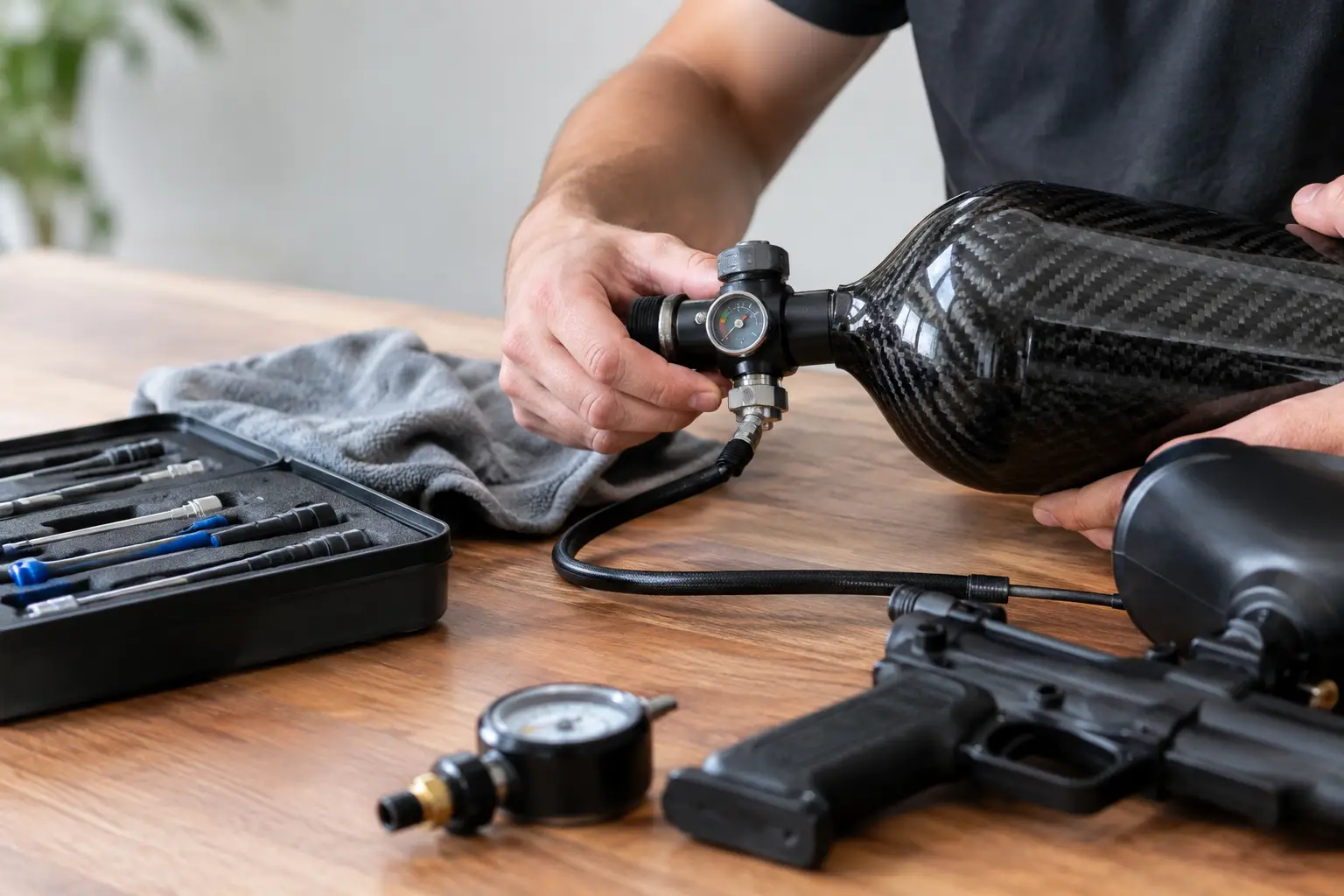
A tank that drops from a full fill to empty between games is frustrating. A tank or regulator that starts hissing during a fill can be a safety issue. Good HPA leak diagnostics are less about guessing which part is bad and more about isolating the leak before you buy parts, tear into a regulator, or show up to the field with no air.
HPA systems are dependable when their components are clean, correctly installed, and maintained. The challenge is that a slow leak can come from several places: the tank regulator, fill nipple, burst disks, output seal, hose fittings, quick disconnect, engine, or marker valve. The sound may seem like it is coming from one area while the actual leak is a few inches away.
HPA Leak Diagnostics: Start Safe and Simple
Before checking anything, treat the system as pressurized equipment. Keep the tank pointed away from people, wear eye protection, and do not put your face near a fitting or burst disk while it is under pressure. Never attempt to disassemble a pressurized tank regulator. Tank regulators contain high-pressure components and should be handled by trained service personnel when internal work is needed.
Start with a fully aired tank, but do not chase a leak by repeatedly tightening random fittings. That can damage threads, crush an O-ring, or turn a small repair into a replacement part. Listen first. A sharp, steady hiss usually means a larger leak at a connection, burst disk, or damaged seal. A faint hiss that only appears after the system sits for a few minutes may point to an internal marker leak or a worn O-ring.
The most useful tool for finding an external leak is a small amount of soapy water in a spray bottle. Apply it sparingly to accessible external joints and watch for bubbles. Keep liquid out of the regulator body, gauge face, electronics, trigger switches, and airsoft control boards. Wipe everything dry after testing.
If you hear a leak but cannot see bubbles, remove the tank from the marker only after the marker is safely degassed according to its instructions. Then test one part of the system at a time. Separating the tank, remote line, and marker is the quickest way to stop guessing.
Check the Tank Regulator First
A tank that loses air while it is not connected to anything narrows the problem down immediately. Check the fill nipple, burst disks, gauge area, and regulator-to-bottle seam. Do not use the bottle seam as a place to tighten or twist the regulator. If that area is leaking, the tank should be inspected by a qualified HPA service provider.
Fill Nipple Leaks
A fill nipple can leak because dirt has reached the valve, the internal seal is worn, or the valve pin is sticking. If the leak starts immediately after filling, it may be contamination from a fill station or a damaged internal O-ring. A quick burst of air right after disconnecting the fill whip can be normal. Continuous leaking is not.
Keep the fill nipple cap on whenever the tank is not being filled. That small cap keeps dirt, paint, sand, and moisture out of a part that sees high pressure every time you air up. If cleaning does not solve the issue, replacing the fill nipple is often more sensible than trying to rebuild it at home.
Burst Disk Leaks
Burst disks are safety devices, not plugs to be tightened until the sound stops. If air is venting from a burst disk, stop using the tank. The disk may have failed, the regulator may be over-pressurizing, or the tank may have been exposed to heat or damage. Replacing a burst disk with the wrong pressure rating is dangerous and can defeat the regulator’s safety design.
A burst disk issue deserves professional attention, especially if it happens more than once. Do not assume a new disk alone fixes the underlying cause.
Output Seal and ASA Connection
If the leak begins only when you screw the tank into a paintball marker ASA or an airsoft regulator adapter, inspect the tank’s output O-ring first. This is one of the most common and inexpensive HPA fixes. A flattened, cut, dry, or missing O-ring can leak around the connection or make the tank difficult to install.
Use the correct size and material O-ring for the tank output. A little paintball-safe lubricant on the O-ring can help it seat, but excess oil attracts debris. If a fresh output O-ring still leaks, the marker ASA pin or adapter may be worn, misadjusted, or incompatible.
Follow the Air Path Through the Line
Remote lines and airsoft HPA lines take abuse. They get pulled around bunkers, stepped on in staging areas, pinched in gear bags, and twisted during tank changes. Inspect the hose for cuts, abrasion, loose braid, damaged threads, or a fitting that turns too easily.
Use soapy water around the line’s threaded connections, quick disconnect, and fitting collars. Bubbles at a threaded fitting can mean the fitting needs proper resealing, but do not crank it down blindly. Different fittings use different thread types, and thread tape applied incorrectly can enter the air system or prevent a proper seal.
If a quick disconnect leaks only when coupled, inspect the male and female ends for worn O-rings, dirt, or a bent release collar. If it leaks when disconnected, the internal valve may be failing. Quick disconnects are convenient wear items, not lifetime parts, particularly for players who disconnect tanks often.
For airsoft systems, also look closely at the line where it enters the grip, engine, or regulator. A line can appear fine until it is bent into the same position it sees during play. Move the line gently while the system is pressurized and listen for a change in the leak. Do not yank on the line or use sharp tools around it.
Isolate Marker Leaks by Their Symptoms
Once the tank and line have passed inspection, air loss is likely inside the marker or engine. The exact diagnosis depends on the platform, but the symptom still tells you where to look.
A paintball marker that leaks down the barrel often has a valve, cup seal, poppet, or bolt-related sealing issue. A leak from the grip frame, vent, or rear section can point to a regulator or internal pressure-control problem. Many modern electronic markers also need the correct input pressure. Running a setup outside the manufacturer’s specification can create leaks, poor consistency, or damaged seals.
An HPA airsoft replica that leaks through the barrel may have an engine poppet or nozzle seal issue. A leak from the grip or trigger area can involve the engine, air line connection, or solenoid assembly. If the engine fires inconsistently, leaks only after shooting, or vents when the trigger is released, resist the urge to adjust every setting at once. Record the tank pressure, regulator setting, and when the leak begins. That information makes a repair much faster.
A useful test is to air the system without firing it. Then fire a few controlled shots and listen again. A leak that appears only after cycling often relates to a moving internal seal. A leak that never changes may be at a static O-ring, fitting, or valve seat.
Common Mistakes That Make Leaks Worse
The wrong repair approach can cost more than the original leak. Avoid these four mistakes:
- Using petroleum-based oil or grease where the manufacturer calls for a specific pneumatic lubricant.
- Removing tank regulator parts while the tank is pressurized or attempting to modify safety components.
- Installing random O-rings because they look close enough, rather than matching the correct size and material.
- Turning regulator adjustments or dwell settings to compensate for a mechanical leak.
There is also a budget trade-off worth considering. Replacing a visible O-ring or a worn quick disconnect is a reasonable maintenance job for many players. Internal tank regulator work, recurring burst-disk failures, and unfamiliar marker-engine leaks are better handled by a technician. The price of proper service is usually lower than replacing a damaged regulator, board, solenoid, or tank.
When to Bring It to a Pro Shop
Bring the full setup – tank, regulator, line, marker, and any adapters – when the source is unclear. A leak may only show up when components are connected together, and a technician can test the complete air path rather than replacing parts one at a time.
This is especially worthwhile if the tank has been dropped, exposed to excessive heat, is past its hydrostatic test date, vents through a burst disk, or has an issue at the regulator-to-bottle connection. Those are not problems to troubleshoot in a parking lot before a game.
At Combat Zone Sports, players can bring in their HPA setup for practical diagnosis and repair guidance. Whether you are running a paintball marker, an HPA airsoft engine, or a remote-line setup, bringing the actual gear helps identify the real issue without selling you parts you do not need.
A quiet, stable HPA system lets you focus on the next game instead of watching the gauge all day. Check your tank and line before loading up, carry a few correct spare O-rings, and address a new hiss while it is still a small problem.