
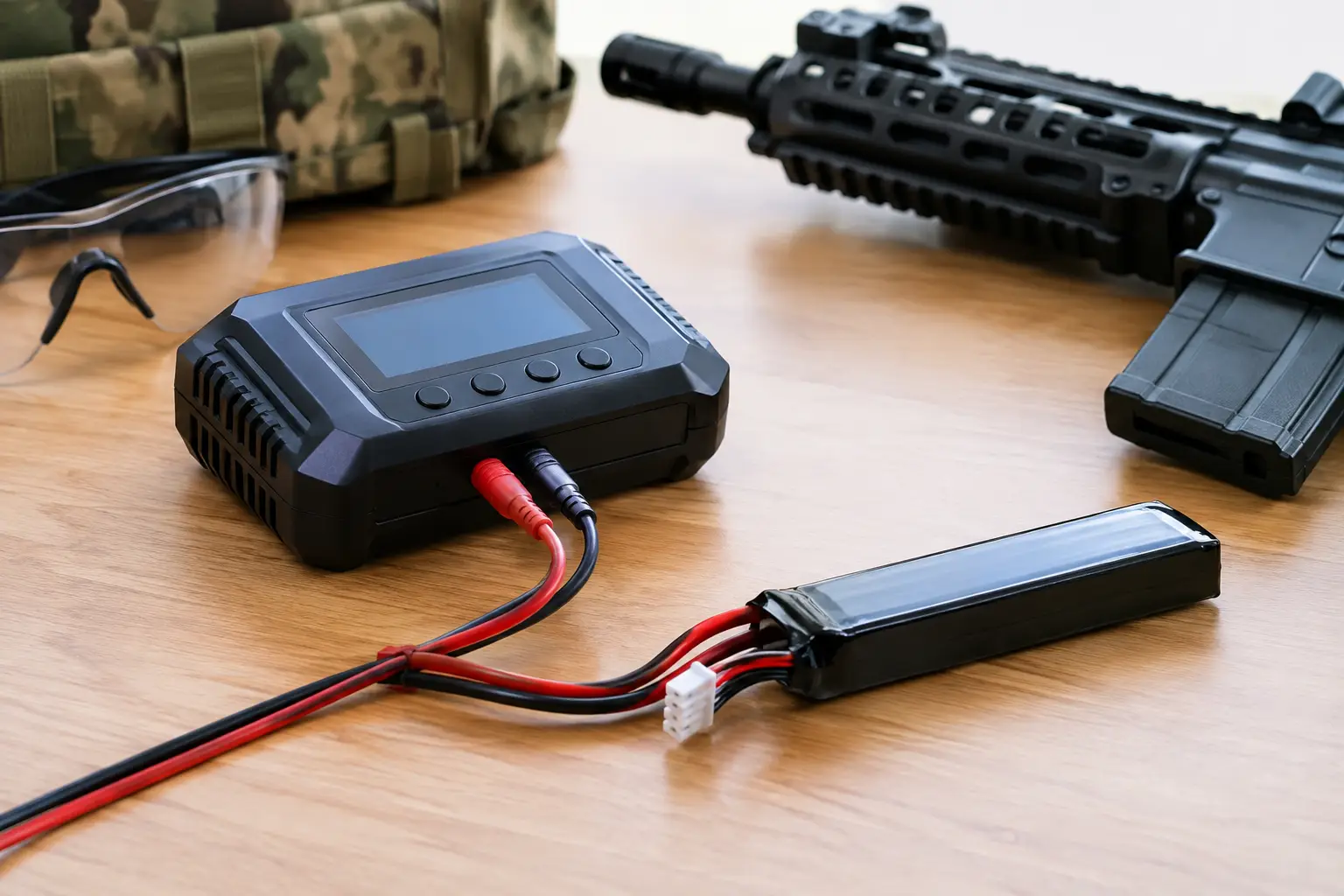
A LiPo battery can give an airsoft replica crisp trigger response and dependable performance all day, but it is not a battery to plug in and forget. Learning how to charge LiPo safely protects your gear, your home, and your next game day. The process is straightforward once you use the right charger, verify the settings, and treat every pack with the respect it deserves.
Start With a Real LiPo Balance Charger
Use a charger specifically designed for lithium polymer batteries. A basic wall charger that came with an older airsoft gun may be fine for a NiMH battery, but it is not a safe substitute for a programmable LiPo balance charger.
A proper charger lets you select battery chemistry, cell count, charge rate, and charging mode. For most airsoft players, balance charge mode is the right choice. It monitors the individual cells through the battery’s small white balance connector and brings them to the same voltage. That matters because one weak or overcharged cell can turn a usable pack into a safety problem.
Most airsoft LiPo batteries are either 2-cell, labeled 7.4V, or 3-cell, labeled 11.1V. The voltage printed on the shrink wrap is only part of the setup. Before charging, count the wires on the balance plug if you are uncertain: a 2S battery has three small wires, while a 3S battery has four. Never guess the cell count on the charger.
How to Charge LiPo Safely: Check the Battery First
Give every battery a quick inspection before it goes on the charger. It takes less than a minute and can save you from charging a pack that should be retired.
Do not charge a battery that is swollen, puffed, torn, leaking, unusually hot, or has damaged wires or connectors. A little looseness in an outer shrink wrap is one thing. A pack that feels inflated, has a chemical smell, or shows exposed foil is another. Set it aside and bring it to a proper battery recycling location. Do not put a damaged LiPo in the household trash.
Check the main connector as well. A loose T-Plug, Deans connector, XT-style connector, or damaged adapter can create resistance and heat. If the connector gets hot during use or charging, stop using the battery until the connection is repaired.
If the battery has just come out of a game, let it cool to room temperature before charging. Charging a hot pack is unnecessary stress. The same rule applies if it has been sitting in a hot car, which is especially relevant during a Florida summer.
Set the Correct Charge Rate
For day-to-day airsoft use, charging at 1C is the safe, sensible default unless the battery manufacturer clearly states otherwise. The 1C rate matches the battery’s capacity measured in amp hours.
For example, a 1200mAh battery equals 1.2Ah, so its 1C charging rate is 1.2 amps. An 1800mAh pack should generally be charged at 1.8 amps. A 2200mAh pack charges at 2.2 amps.
Higher charge rates may be printed on some premium batteries, but faster is not always better. Fast charging creates more heat, puts more stress on the cells, and rarely makes enough difference to justify the trade-off for a typical weekend game. If you need packs ready sooner, having a second properly maintained battery is usually the better move.
Before pressing start, confirm four items on the charger screen: LiPo chemistry, balance charge mode, cell count, and charge current. The charger should also confirm the cell count it detects. If the charger says 3S but you believe you are charging a 2S pack, stop and find out why. Do not override a mismatch just to make the charger run.
Charge in a Safe Place and Stay With It
Put the battery and charger on a nonflammable surface away from clutter, fuel, paintballs, aerosol products, paper, clothing, and direct sun. A clear concrete floor, ceramic tile surface, or other heat-resistant area is better than a bed, couch, garage workbench covered in gear, or car seat.
Use a quality LiPo safety bag or a purpose-built fire-resistant charging container. A LiPo bag helps contain sparks and debris if a pack fails, but it does not make an unsafe setup safe. It is still not a reason to charge inside a closed drawer, sealed metal box, or crowded gear bag. A sealed metal container can build dangerous pressure if a battery vents.
Most importantly, remain nearby while the battery charges. You do not have to stare at the charger screen for an hour, but you should be close enough to notice an alarm, smell something unusual, or shut down the charging process quickly. Avoid overnight charging, charging while you are at work, or plugging in a battery and leaving for lunch.
Keep children and pets away from the charging area. This is basic shop discipline: clear space, correct equipment, and no distractions.
Watch for Warning Signs While Charging
A healthy LiPo should charge without swelling, smoking, hissing, or becoming excessively hot. Slight warmth can occur, particularly near the end of a charge, but a pack that is too hot to hold comfortably needs attention. Stop the charge, disconnect it carefully, and move it to a safe nonflammable area.
If a charger displays an error, do not keep restarting it until it accepts the battery. Errors involving voltage, balance connection, or cell count are the charger telling you that something needs to be checked. Inspect the balance plug, verify your settings, and test the pack with a battery checker if you have one.
Never charge a LiPo by using only the main lead when the charger is set for a balanced charge. The balance connector is part of the safety process. Also avoid cheap, questionable adapters. Airsoft players often need connector adapters for compact battery compartments, but every adapter is another point where polarity or connection quality can go wrong.
Do Not Run the Battery Too Low at the Field
Safe charging starts with how the battery is used. LiPo cells should not be drained below roughly 3.0 volts per cell, and it is better not to push them that far. In practical airsoft terms, stop using the battery when your replica begins to cycle slowly, sounds strained, or loses its normal response.
An electronic trigger unit with low-voltage cutoff is a major advantage, especially on a 3S setup. It can prevent over-discharge before the battery is damaged. If your replica does not have cutoff protection, use a LiPo alarm or make a habit of checking voltage after games.
Do not keep pulling the trigger once the battery is clearly weak. That last bit of use can take a cell from recoverable to permanently damaged. A battery that repeatedly comes back from the field deeply discharged will lose capacity, puff sooner, and become less reliable when you need it.
Store LiPos at Storage Voltage
A fully charged battery is ready for the next game, but it is not the best condition for long-term storage. If you will not use the pack within a few days, use your charger’s storage mode. Most LiPo batteries should be stored around 3.7 to 3.85 volts per cell.
Storage mode can either charge or discharge the battery to reach that range. Keep stored packs in a cool, dry location, inside a LiPo bag or suitable fire-resistant container, away from heat and direct sunlight. Do not leave them in a vehicle, garage attic, or anywhere temperatures climb sharply.
Check stored batteries every month or two. If a pack is swelling or one cell is dropping much lower than the others, it is time to take it out of service.
A Simple Routine That Keeps Game Days Moving
The best charging routine is boring, repeatable, and safe. Inspect the pack, let it reach room temperature, connect both the main lead and balance lead, select LiPo balance charge, confirm the cell count and 1C rate, then stay nearby until the charger finishes.
For players running high-speed builds or compact battery compartments, battery selection and charging habits matter just as much as the replica setup. If you are unsure whether a 7.4V or 11.1V LiPo suits your airsoft gun, or if a battery is still safe after a hard day of use, bring it by Combat Zone Sports. Honest advice before you buy another pack is a lot cheaper than replacing a damaged replica – or dealing with a preventable battery incident.