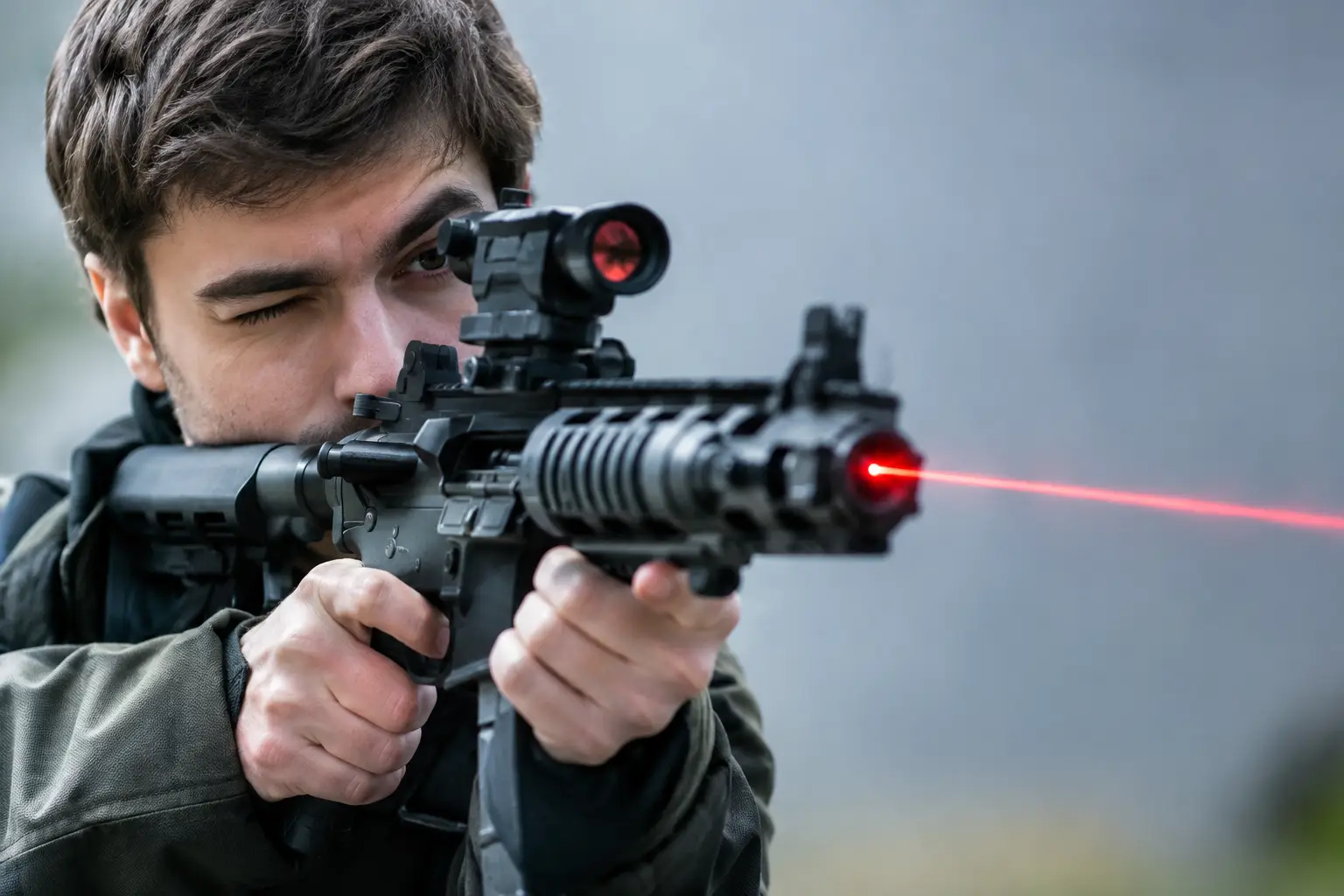
A laser on an airsoft replica can look like a small accessory, but it deserves more thought than a rail-mounted light or foregrip. Can airsoft lasers damage eyes? Yes. A direct beam from the wrong laser, or even a brief close-range exposure from a laser of unknown output, can create a real risk of eye injury. The fact that a replica fires plastic BBs does not make its laser harmless.
For most players, the practical answer is simple: do not aim a laser at any person, do not assume field-rated goggles protect against laser light, and do not buy or use a unit with questionable labeling. A laser can be useful for specific training setups, but it is not necessary for most airsoft games.
Why airsoft laser exposure is different from a BB hit
Airsoft eye protection is designed to stop physical impact. Properly rated goggles or a full-face mask can prevent a BB from striking the eye, which is exactly why field rules require them. A laser creates a different hazard. Instead of hitting the surface of the lens, a concentrated beam can pass through the eye’s normal focusing system and concentrate on the retina.
That is the concern with a direct beam. The retina is sensitive tissue at the back of the eye, and it does not have pain receptors that reliably warn you at the moment of exposure. A person may blink or look away, but blink reflexes are not a safety plan for an unknown or overpowered laser, especially at close range.
Risk depends on the laser’s wavelength, output power, beam quality, distance, exposure time, and whether the beam is direct or reflected. A quick glimpse of a low-power, properly classified visible laser is not the same situation as staring into an unmarked high-output unit. Still, at an airsoft field, players move unpredictably, engage around corners, and wear different eye protection. That makes intentional use on people a bad call.
Can airsoft lasers damage eyes behind goggles?
They can. Standard airsoft goggles, glasses, and masks are tested for impact resistance, not necessarily for laser protection. Clear polycarbonate can block some ultraviolet light, but that does not mean it provides the optical density needed to attenuate a visible red, green, or infrared laser safely.
True laser-protective eyewear is made for a specific wavelength range and power level. It has a stated optical-density rating and is selected for a particular industrial, medical, or training application. That is very different from putting on tinted shooting glasses or a pair of field goggles. Dark lenses can actually make a visible laser feel less intense while causing the pupil to open wider in lower light, so they are not a substitute either.
Do not assume a mesh mask solves the problem. Mesh may stop a BB under some conditions, but it has openings that can allow light through, and it is not laser protection. For airsoft, use eye protection approved for impact protection by your field. For laser hazards, avoid exposing people to the beam in the first place.
Laser class labels matter, but labels can be wrong
Most consumer laser products carry a class designation. In broad terms, lower classes are intended to present less risk during normal use, while higher classes can create a greater eye hazard. A commonly seen Class 3R visible laser may be marketed as a low-power aiming laser, but it is still not something to point at a player, teammate, spectator, or vehicle driver.
The bigger problem in the airsoft and tactical-accessory market is that labels are not always trustworthy. Cheap imports may have vague markings, no class information, or an output claim that does not match the actual unit. Green lasers have earned a particularly mixed reputation because some inexpensive designs can vary in output or produce unwanted infrared light if poorly made.
A low price and a bright beam are not proof that a laser is good. In fact, an unusually bright unit with no clear manufacturer information should be a reason to leave it off your replica. If you cannot identify the maker, stated output, wavelength, class, battery requirements, and operating instructions, you do not have enough information to make a safe decision.
Do not confuse lasers with red dots or weapon lights
This mix-up causes plenty of unnecessary worry and some bad buying decisions. A red-dot sight projects an illuminated aiming point onto its own lens for the shooter to see. It is not designed to project a beam downrange. A holographic-style optic works differently internally but likewise is not a visible aiming laser pointed at other players.
A weapon light sends broad illumination forward. It can be distracting at close range and should still be used with common sense, but it is not the same concentrated-beam hazard as a laser. An infrared laser is another category entirely. You may not see it without night vision, but invisible does not mean eye-safe. Treat IR aiming devices with the same or greater caution, particularly if their specifications are unclear.
For most game-day players, a quality red dot or low-power optic is the better choice. It lets you aim while keeping the dot in your own sight picture rather than putting a beam on someone else. It also works more consistently in daylight, where many visible lasers are difficult to see anyway.
A practical laser policy for airsoft players
Fields set their own rules, and many ban visible or infrared lasers outright. Respect that rule even if your laser is labeled low power. A field ban is not about ruining anybody’s loadout. It removes a hazard that referees cannot reliably manage during fast, close-range games.
If a field allows lasers for a specialized event or training session, establish the rules before anyone steps onto the course. The safest operating habits are straightforward:
- Never use a laser to identify, intimidate, signal, or tag another person.
- Keep the laser switched off during normal play unless the event has a clearly defined, supervised purpose for it.
- Activate and zero the laser only on a safe target area, with no people, reflective surfaces, or open sightlines beyond the target.
- Remove it from the replica if the switch can be bumped on, the unit flickers, or the output and class cannot be verified.
Zeroing deserves special attention. Secure the replica, use a proper backstop, and make adjustments in a controlled area. Avoid mirrors, polished metal, glass, water, and shiny target hardware. Reflections are usually less hazardous than a direct beam, but a reflection from a smooth surface can still be surprisingly intense at the wrong angle.
What to do after a possible laser exposure
If someone takes a direct beam to the eye and notices lingering spots, flashes, blurred vision, color changes, pain, headaches, or any change in vision, stop playing and seek prompt medical evaluation. Do not tell them to “walk it off” or decide it is fine because their goggles were on. Vision symptoms after a direct laser exposure deserve professional attention.
Even when no symptoms are obvious, document what happened if possible: the laser type, color, stated class, distance, duration, and whether it was direct or reflected. That information can help a clinician assess the situation. Retire the questionable device until it can be identified and tested properly.
Choose gear that helps your game without adding risk
A well-set-up airsoft replica does not need every accessory on the rail. A sling, light, optic, spare battery, and dependable eye protection will usually do more for a player’s performance than an aiming laser. New players especially should spend their budget on field-legal protective gear, magazines, batteries, and a reliable primary before chasing accessories that may not be allowed.
If you are building a replica and are unsure whether an accessory makes sense for your local field, bring it in and ask before game day. At Combat Zone Sports, the goal is an honest setup that works with your budget and keeps you ready to play, not a pile of gear you cannot safely use. When there is any doubt about a laser, leave it off the replica and keep the game focused on good judgment, good eye protection, and safe hits.