
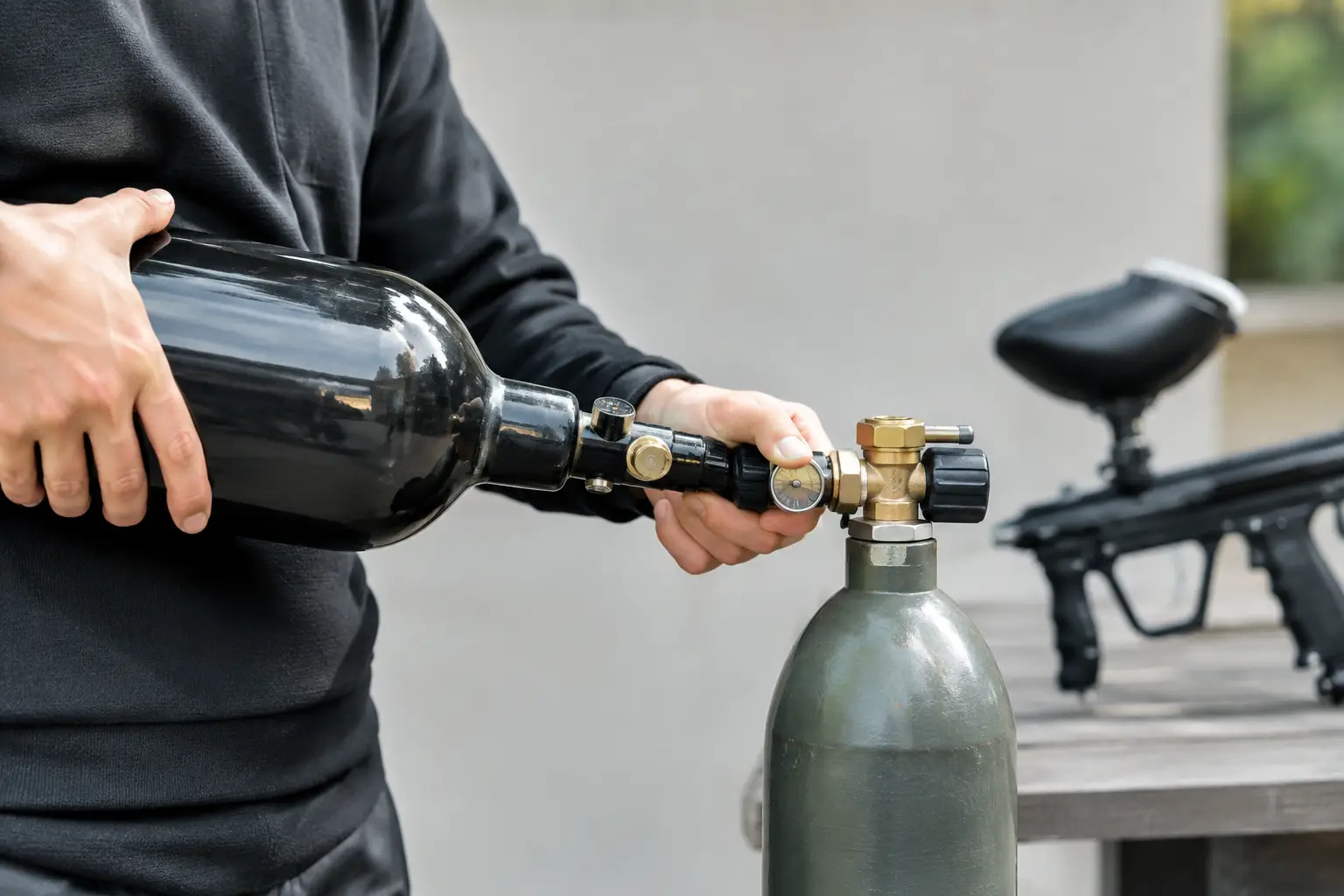
A dead air tank can turn a solid game day into a long wait on the sidelines. Getting a co2 tank refill for paintball is simple when you use the right bottle, fill it at a qualified location, and understand what CO2 does differently from compressed air. The goal is not just to get gas in the tank. It is to keep your marker consistent, your equipment in good shape, and your day moving.
CO2 remains a practical choice for many mechanical paintball markers, especially for players who want a straightforward and affordable setup. But it has limits. Florida heat, rapid firing, and newer marker designs can all change whether CO2 is the right air source for your setup.
Check Your CO2 Tank Before a Refill
Start with the bottle itself. A refill station should inspect the tank before putting it on the scale, but players should know what they are looking at too. A paintball CO2 tank needs a readable hydrostatic test date, a sound valve, intact burst disks, and no major dents, deep gouges, corrosion, or damaged threads.
Most refillable paintball CO2 tanks are aluminum bottles in sizes such as 9-ounce, 12-ounce, 16-ounce, and 20-ounce. The number refers to the weight of CO2 the bottle is designed to hold, not its total weight. A 20-ounce tank, for example, weighs considerably more than 20 ounces when it is full because that number does not include the bottle and valve.
Do not confuse a refillable paintball tank with a disposable 12-gram cartridge. The small cartridges used in some pistols, stock-class markers, and compact setups are single-use. They are not made to be refilled. Trying to refill one is unsafe and can damage the cartridge or create a serious pressure hazard.
Hydrostatic testing matters because tanks live under pressure. Test intervals vary by cylinder type and markings, but many aluminum CO2 paintball bottles require retesting every five years. If the date is expired, scratched beyond safe inspection, or the valve is questionable, replace or properly service the tank rather than trying to squeeze out one more day of use.
How a CO2 Tank Refill for Paintball Works
A proper CO2 fill is done by weight. The technician connects the tank to the filling equipment, chills or fills the bottle as needed, and uses a scale to make sure it receives the correct amount of liquid CO2. Filling strictly by pressure is not reliable because CO2 pressure changes with temperature.
That temperature factor is why a tank may seem underfilled or over-pressurized depending on where it has been sitting. A cold bottle can accept liquid CO2 differently than a warm one. A qualified fill avoids guessing, leaves appropriate room for expansion, and checks the bottle for leaks before handing it back.
CO2 is stored as liquid and gas in the same bottle. When your marker fires, liquid CO2 inside the tank changes to gas to replace what was used. This process pulls heat from the tank. During normal recreational play, that is usually manageable. During fast strings of shots, the tank can get cold enough that pressure drops and velocity becomes less consistent.
A little frost around the valve during use is common with CO2. Heavy frosting, sputtering shots, a dramatic velocity drop, or liquid CO2 entering the marker are signs to stop and check the setup. A loose tank O-ring, worn valve seal, or incompatible marker configuration can turn a minor issue into a messy repair.
CO2 or HPA: Choose for Your Marker and Play Style
CO2 is not automatically outdated, and HPA is not automatically necessary. The better choice depends on your marker, your budget, and how you play.
CO2 often works well with many classic mechanical markers and simple blowback designs. It is widely understood, can be economical to fill, and makes sense for players who shoot at a relaxed pace. A properly maintained mechanical marker on CO2 can still be a dependable game-day setup.
HPA, also called compressed air or nitrogen, provides more stable pressure through changing temperatures and rapid firing. That consistency is a major reason many modern electronic, spool-valve, and tournament-oriented markers specify HPA only. If a marker manual says compressed air only, take it seriously. Running CO2 through a marker that is not designed for it can damage seals, regulators, and internal components.
Central Florida players should also think about heat. Never leave a filled CO2 tank in a hot vehicle, direct sun, or enclosed gear bag for extended periods. CO2 pressure rises as temperature rises. The tank’s safety systems are there for a reason, but preventing excessive heat exposure is the smart move.
If you are unsure which system fits your marker, bring the marker and tank with you when you shop. It is far better to confirm compatibility before buying an air system than to pay for repairs caused by the wrong one.
A Quick Pre-Game Tank Check
Before heading out, give your air system a practical inspection. These checks take only a few minutes and can prevent a leak from ruining your first game.
- Read the hydro date and make sure the bottle is still within its service interval.
- Look over the valve, burst disks, tank threads, and bottle body for damage or corrosion.
- Check the tank O-ring where it screws into the marker’s ASA. Replace it if it is flattened, cut, or missing.
- Gas up the marker carefully and listen for a steady hiss around the ASA, valve, or fittings.
- Chronograph the marker at the field after the tank is installed, especially if you have changed air sources or made adjustments.
Do not use tools to force a CO2 tank into your marker. The tank should thread in smoothly. If it will not engage correctly, stop. Cross-threading an ASA or tank valve can turn a simple O-ring issue into an expensive repair.
When removing a tank, follow your marker’s normal degassing procedure. Some markers vent remaining gas as the tank is unscrewed, while others have an on/off ASA that makes removal easier. Either way, keep the marker pointed in a safe direction and keep fingers away from the valve pin and any escaping gas. CO2 can cause a cold burn when it vents quickly.
Getting Better Performance From CO2
The biggest CO2 performance issue is rapid fire. As the tank chills, pressure falls. You may see lower velocity, reduced range, or inconsistent shots. A larger tank can help because it has more liquid reserve and more surface area, but it does not eliminate the physics of rapid discharge.
For recreational players, the practical answer is usually to shoot at a sensible pace, keep a spare filled tank if the field allows it, and chronograph after breaks or major temperature changes. Do not chase velocity by turning up marker adjustments when the tank is cold. Once the bottle warms, the marker may shoot hot.
Older marker setups sometimes use anti-siphon tubes, expansion chambers, remote lines, or specific valve configurations to manage CO2. Those parts can help in the right setup, but they are not universal upgrades. An anti-siphon tank installed for one marker may be wrong for another because the tube must align with that marker’s ASA position. Ask before swapping parts between markers.
When It Is Time to Replace the Tank
Replace the tank when it is out of test, visibly damaged, leaking from a valve that cannot be economically serviced, or no longer appropriate for your marker. A fresh O-ring or valve service can solve many small leaks, but a damaged cylinder is not a repair project.
The same goes for players moving from a basic mechanical setup to an electronic marker. That may be the right time to move to HPA rather than continuing to invest in CO2 accessories that do not match the new platform. Honest gear advice should save you from buying parts twice.
For players around Cocoa, Melbourne, Palm Bay, Orlando, Daytona Beach, and the Space Coast, call ahead before making a special trip for a fill. Refill availability, tank inspection needs, and service options can vary by day and equipment. At Combat Zone Sports, bringing in the marker with the tank gives the pro-shop team a better chance to spot compatibility or leak issues before your next game.
A filled tank is a small part of your setup, but it affects every shot you take. Keep the bottle in date, fill it correctly, protect it from heat, and use the air source your marker was built to run. That is how you spend more of game day playing and less of it diagnosing preventable problems.