
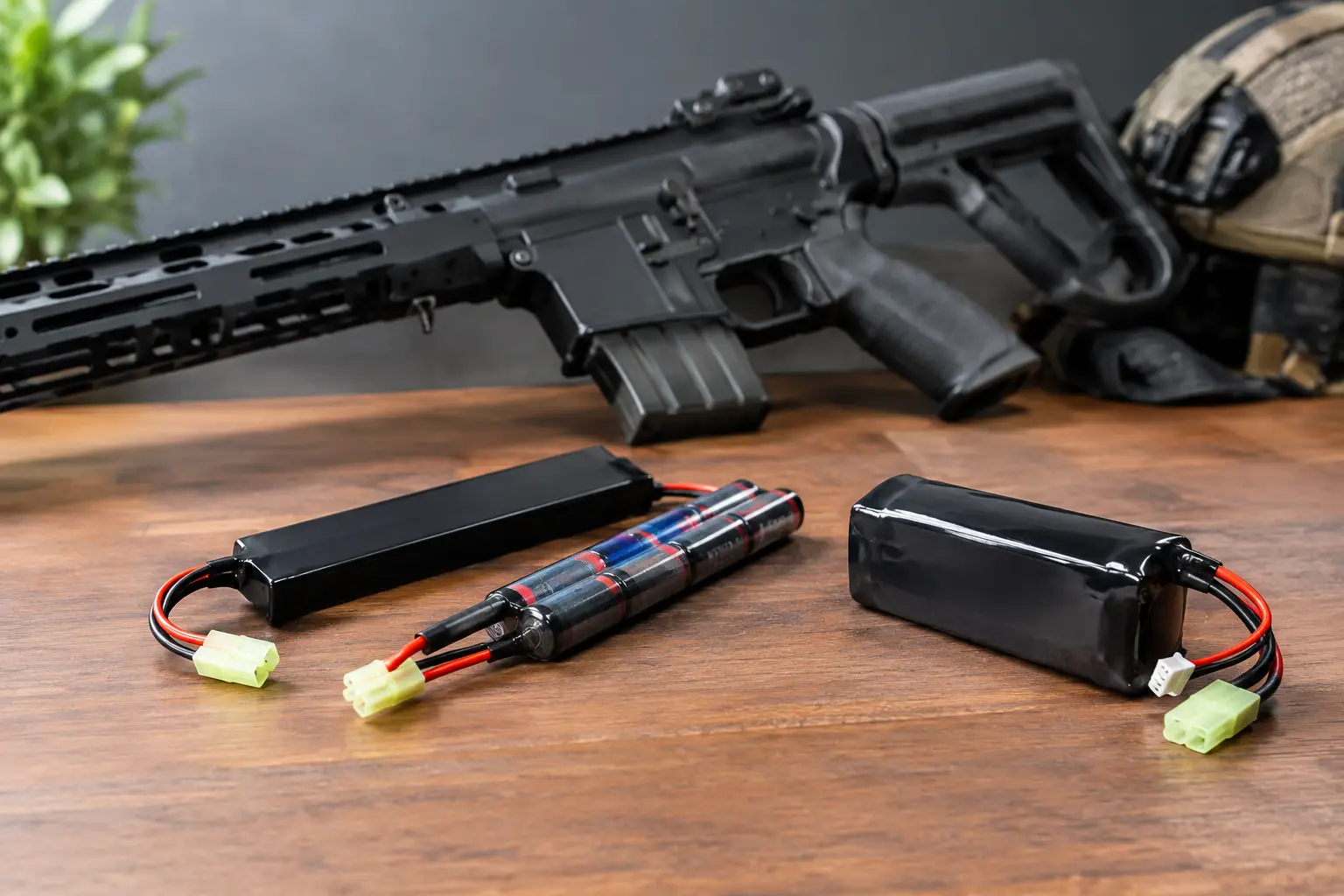
A battery that does not fit, cannot supply enough current, or dies before the afternoon game can turn a good AEG into dead weight. The best airsoft battery for AEG use is not automatically the highest-voltage pack on the shelf. It is the battery that fits your stock or handguard, matches your gun’s internals and wiring, and gives you dependable trigger response for the way you play.
For many current AEGs, that means a quality 7.4V LiPo. For a basic rental-style setup, an older gun, or a player who wants the simplest charging routine, a NiMH pack can still make sense. The right answer depends on the rifle, not hype on the package.
Start With Your AEG, Not the Battery Label
Before choosing voltage, capacity, or connector type, check the battery space in your gun. An M4 with a crane stock may need a slim nunchuck pack. A rifle with a buffer-tube compartment needs a narrow stick battery. An AK or full-stock AEG may accept a larger brick-style pack, while many compact PDW and SMG builds have very limited room.
Measure the usable space if you can. Include the room needed for wires, connectors, and the stock or cover to close properly. A battery that technically fits only when the wires are crushed is not a fit. Pinched wiring can create intermittent power problems and unnecessary wear.
Also check the connector. Mini Tamiya plugs are common on entry-level AEGs, while Deans or T-plug connectors are popular on upgraded builds because they provide a firmer connection and lower electrical resistance. Do not force mismatched connectors or rely on loose adapters as a permanent solution. If your rifle is being rewired, upgrading the connector at the same time is usually the cleaner route.
Best Airsoft Battery for AEG Players: LiPo or NiMH?
Why 7.4V LiPo Is the Go-To Choice
A 7.4V lithium polymer battery is the practical sweet spot for a large number of modern AEGs. Compared with a typical 8.4V or 9.6V NiMH pack, a good 7.4V LiPo often delivers sharper trigger response and more consistent performance as the battery drains. That consistency matters when you are taking quick semi-auto shots or trying to keep your rifle responsive late in the day.
A 7.4V LiPo is generally a smart choice for stock guns that are LiPo-ready, standard recreational rifles, and many upgraded AEGs running a decent motor and electronic trigger unit. It gives performance without placing the same demand on the gearbox as an 11.1V LiPo.
The trade-off is that LiPos require more care. Use a charger with LiPo balance charging capability, stop using a pack if it is swollen or damaged, and never leave it charging unattended. A low-voltage alarm or an AEG with low-voltage cutoff helps prevent over-discharging, which can permanently damage a LiPo.
When a 9.6V NiMH Battery Still Makes Sense
NiMH batteries are more forgiving for new players. They do not require cell balancing, they tolerate basic handling better, and they are a reasonable option for older AEGs that were designed around NiMH power. A quality 9.6V NiMH pack can provide reliable game-day use in a compatible rifle.
They are also a sensible choice when the gun has no MOSFET, no low-voltage protection, and the owner does not want the added responsibility of LiPo care. You will usually give up some trigger response and may notice a more gradual slowdown as the pack empties, but reliability and simplicity have value.
Be Careful With 11.1V LiPo Power
An 11.1V LiPo can make an AEG feel dramatically faster. Trigger response improves, the motor cycles quicker, and full-auto rate of fire increases. That is appealing, especially for experienced players building a responsive semi-auto setup.
It can also expose weak parts. Higher voltage increases stress on electrical contacts, gears, piston components, and the motor. An AEG with basic trigger contacts and no MOSFET can suffer accelerated arcing and wear with an 11.1V pack. Even rifles advertised as 11.1V-ready benefit from proper shimming, a healthy motor, suitable gears, and good battery wiring.
Use 11.1V only when the manufacturer confirms compatibility or a qualified tech has set the rifle up for it. More voltage is not a free upgrade.
Capacity and C Rating: What the Numbers Mean
Battery capacity is measured in milliamp-hours, or mAh. A 1200mAh battery stores less energy than a 2000mAh battery, so it will generally provide fewer shots per charge. Capacity does not make the gun shoot harder or faster by itself. It mainly affects runtime.
Choose the highest capacity that fits comfortably in your AEG. For a compact stock, a 1000mAh to 1300mAh LiPo may be realistic. A larger stock or handguard may accommodate 1500mAh, 2000mAh, or more. Players who shoot heavily at long events should carry a properly protected spare rather than cramming an oversized pack into a tight compartment.
The C rating indicates how quickly a battery can deliver current. A battery’s continuous discharge capability is calculated by multiplying capacity by C rating. For example, a 1300mAh battery rated at 20C can theoretically deliver 26 amps continuously. In real use, battery quality matters as much as the printed number, and exaggerated ratings exist.
For most stock AEGs, a reputable 15C to 25C LiPo is usually plenty. High-demand upgraded builds may need more current, particularly with high-torque motors, stronger springs, or fast trigger setups. Buying an extreme C rating for a basic rifle is rarely necessary, but buying a very low-output pack can cause sluggish cycling and heat under load.
Match Battery Shape to Your Rifle
Battery shape causes more purchasing mistakes than voltage. A good battery is useless if it cannot be installed without fighting the wires every time.
A stick LiPo is common in buffer tubes, AK gas tubes, and narrow compartments. Nunchuck or split-cell packs work well in crane stocks because each cell section can sit in a separate stock tube. Brick packs offer strong capacity for full stocks and larger handguards but are too bulky for many modern carbine builds.
If you are buying for a specific AEG, bring the rifle to the shop when possible. Fitment can vary even between two rifles with similar stock styles. A few minutes of checking the compartment can save you from buying a battery that is right on paper and wrong in the gun.
Charging and Storage Are Part of Battery Performance
The best battery will not stay reliable if it is charged incorrectly. For LiPo batteries, use a dedicated balance charger in LiPo mode and charge at the rate recommended by the battery manufacturer. A common conservative rule is 1C charging, meaning a 1300mAh battery charges at 1.3 amps.
Charge on a nonflammable surface, preferably with a LiPo safety bag or suitable fire-resistant container nearby. Inspect packs before and after use. Stop using a battery that has swelling, torn shrink wrap, damaged wires, a loose connector, or unusual heat after normal use.
Do not store a LiPo fully charged for weeks between games. Put it into storage mode, typically around 3.8 volts per cell, if you will not use it soon. For NiMH packs, avoid leaving them on a charger after they are full and recharge them before a game if they have been sitting for an extended period.
A Practical Recommendation for Most Players
For a modern, stock or lightly upgraded AEG, start with a quality 7.4V LiPo that fits correctly, has a sensible capacity for your battery compartment, and uses the proper connector. Pair it with a balance charger and a second battery if you play all-day events. That setup gives most recreational and intermediate players the best mix of response, runtime, and gearbox longevity.
If you own an older AEG or want the simplest setup while learning battery care, a correctly sized 9.6V NiMH remains a dependable choice. If you are considering 11.1V power, treat it as part of a complete performance plan, not a quick fix for a slow rifle.
Combat Zone Sports can help players from Cocoa, Melbourne, Orlando, and across Central Florida check battery fitment, connector compatibility, and whether an AEG is ready for a higher-voltage pack. Bring in the rifle and the old battery if you have it. The right battery should make game day easier, not give you another equipment problem to solve.