
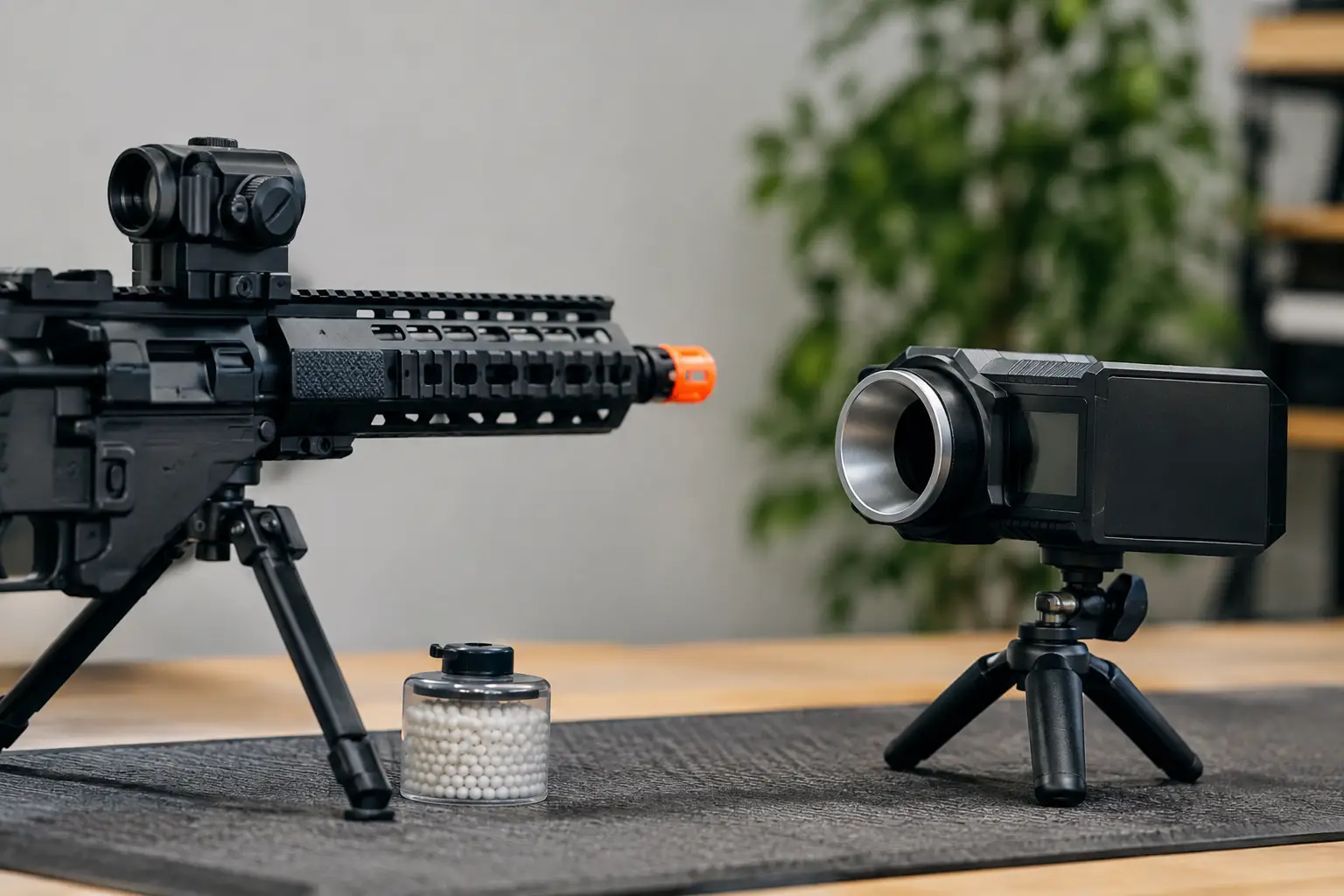
A rifle that felt perfect in the backyard can fail chrono at the field for one simple reason: the settings, BB weight, gas temperature, or battery behavior changed. Knowing how to chronograph an airsoft rifle before game day helps you avoid that surprise, protects other players, and gives you useful information about how your setup is really performing.
A chronograph is not just a pass-or-fail station. It is a diagnostic tool. Whether you run an AEG, HPA rifle, gas blowback rifle, or spring platform, a few careful shots through a chrono can reveal an air leak, feeding issue, unstable regulator, worn bucking, or an upgrade that needs attention.
What an Airsoft Chronograph Measures
Most airsoft chronographs measure muzzle velocity in feet per second, usually called FPS. They calculate that number by timing a BB as it passes between two sensors. Better chronographs also display rate of fire and muzzle energy in joules.
FPS is easy to understand, but joules tell the more complete story because they account for BB weight. A heavier BB can leave the barrel at a lower FPS while carrying similar or greater energy. That matters at fields that chrono by joules or enforce joule limits to prevent players from using heavy BBs to work around an FPS rule.
For example, a rifle shooting 350 FPS with a 0.20 g BB produces about 1.14 joules. Put a heavier BB in the same rifle and the FPS will drop, but the energy may not drop at the same rate. Some setups can even gain energy with heavier ammunition, a behavior players call joule creep. HPA and gas platforms deserve extra attention here, especially with longer barrels or high-volume air systems.
What You Need Before You Chrono
Use the same BBs you intend to play with. That means the same brand, weight, and ideally the same bag or bottle. Cheap, inconsistent BBs create inconsistent readings, and a cracked or poorly polished BB can damage your hop-up or barrel.
You also need eye protection, a safe backstop, and a chronograph set up on a stable surface. Never point the rifle at another person while chronographing. Treat the process like live-fire handling: keep your finger off the trigger until you are aimed through the unit, and keep the muzzle directed toward a safe area beyond it.
For gas rifles, use the gas or CO2 source you will use during play. For HPA, confirm your tank has adequate pressure and your regulator is set where you normally run it. For AEGs, chrono with the battery you plan to use. A nearly depleted battery can change cycling behavior, while an unusually high-voltage battery may push rate of fire higher than expected.
How to Chronograph an Airsoft Rifle Step by Step
Start by setting the chronograph for the BB weight you are using. Many units need the weight entered manually so they can calculate joules correctly. If yours only reads FPS, write down both the BB weight and the velocity for reference.
Set your hop-up to the position you actually use in games. Players sometimes turn hop completely off to get the lowest possible reading, then add hop after passing chrono. That does not show the field staff or you what the rifle does in real use. A properly adjusted hop-up may affect velocity slightly, and it can expose feeding or air-seal problems that disappear with the hop turned off.
Hold the muzzle roughly one to three inches from the chrono opening. Do not press the barrel into the unit or let it touch the sensor housing. Keep the rifle level and centered so the BB passes cleanly through the sensor path. Shooting at an angle can cause error readings or send a BB into the chrono itself.
Fire at least five shots, preferably 10 if you are diagnosing the rifle or preparing for a stricter event. One reading does not tell you much. Record the high reading, low reading, average FPS, and joule reading if available. Fields may use their own process, but your pre-game check should look for consistency, not just a single number below the limit.
A healthy rifle should produce a relatively tight spread. The exact acceptable spread depends on platform and build quality, but a difference of a few FPS is usually much better than a swing of 20, 30, or more. Gas rifles may vary more as magazines cool, but large changes still deserve a closer look.
Match the Field’s Rules, Not Internet Numbers
Every field can set different limits for rifles, DMRs, support guns, and bolt-action platforms. Some measure with 0.20 g BBs and list limits in FPS. Others require you to chrono with the BB weight you will use and judge the rifle in joules. Minimum engagement distances may also change with muzzle energy.
Check the rules before you adjust anything. Do not assume that because a rifle was allowed at one Central Florida game, it will pass at the next one. Field limits are safety rules, not performance suggestions.
If your rifle is close to the limit at home, leave a margin. Temperature, a freshly charged battery, a warm gas magazine, or a different chrono can all move the reading. Building for the absolute maximum is a good way to spend game morning changing springs or sitting out a round.
Understanding Your Results
If your rifle is consistently under the limit and groups well, you are in good shape. More FPS is not automatically better. Range and accuracy depend heavily on hop-up performance, BB quality, barrel condition, and your ability to place shots. A stable 330 FPS rifle shooting quality heavyweight BBs can be more effective than an inconsistent rifle pushed right to the cap.
If your velocity is too high, the correct fix depends on the platform. An AEG may need a lower-power spring, corrected air seal, or inspection of a recently installed barrel or cylinder setup. An HPA rifle may need a lower regulator setting, but do not treat pressure adjustment as the whole answer. Confirm energy with your actual BB weight and verify the setup cannot be adjusted beyond legal limits during play.
For gas blowback rifles, start with the gas type, magazine condition, temperature, nozzle, and valve system. Green gas, propane, red gas, and CO2 do not perform the same way. A rifle that is acceptable on a mild morning can climb in velocity in Florida heat. Let magazines return to a normal temperature between test strings if they become cold from rapid firing.
Why FPS Readings Can Jump Around
Large shot-to-shot variation is usually a mechanical or supply issue, not a chrono problem. In an AEG, common causes include a worn piston O-ring, nozzle-to-bucking seal problems, a cracked tappet plate, inconsistent BB seating, or contamination in the barrel and hop-up. In HPA systems, look for regulator creep, inconsistent air supply, a dirty engine, or a tuning issue.
Gas rifles can show variation from cooldown, weak magazine valves, leaking seals, inconsistent fill levels, or rapid firing. Spring rifles are generally stable, so a sudden FPS spread often points to an air-seal issue, damaged bucking, or a BB problem.
Clean the inner barrel with a proper unlubricated patch and inspect your bucking before making major changes. Avoid putting silicone oil down the barrel as routine maintenance. Oil on the hop-up contact surface can reduce consistency and cause erratic flight.
A Better Pre-Game Chrono Routine
Chrono the rifle after it has been assembled exactly as you will use it: intended barrel and suppressor, normal hop setting, game battery or air system, and game BBs. Fire a few settling shots into a safe backstop first, then record a 10-shot string. If the rifle is near a field limit, test again after a short pause and, for gas platforms, when the magazines are warm.
Write the result on your phone or keep a small setup note in your gear bag. Track BB weight, average FPS, joules, battery type or regulator pressure, and date. This makes troubleshooting much easier after an upgrade or repair because you have a real baseline instead of relying on memory.
If your rifle will not produce consistent readings or you are unsure whether an upgrade is appropriate, bring it to a pro shop before the event. Combat Zone Sports can help Central Florida players diagnose airsoft performance issues and recommend repairs or upgrades that fit the rifle, the field rules, and the budget. A rifle that shoots safely and consistently is the one you can trust when the game starts.