
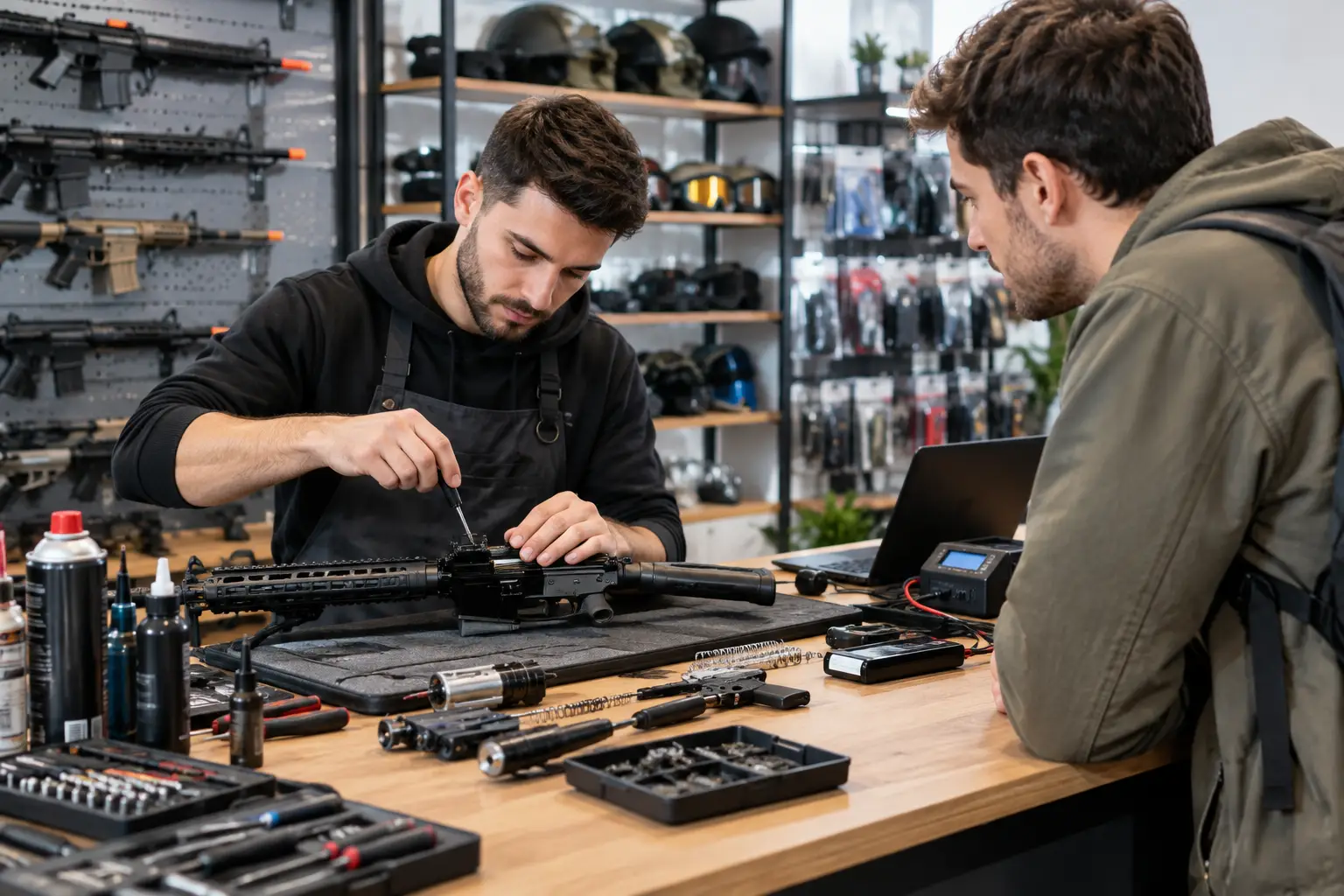
Your replica may still fire, but that does not mean it is ready for the next game. A slow trigger response, inconsistent shots, feeding problems, or a battery that quits early can turn a fun day into time spent at the staging table. The right airsoft gun upgrade service starts with figuring out what is actually holding your setup back, not loading a cart with parts that may not work well together.
For some players, the right answer is a simple repair and tune. For others, a carefully planned upgrade can make a rifle feel faster, more consistent, and more dependable. The difference comes down to your platform, your playing style, your field rules, and the condition of the gun before any new parts go in.
What a Good Airsoft Gun Upgrade Service Should Do
An upgrade is more than swapping parts. A quality service begins with an inspection of the gun’s current condition. If a gearbox has worn gears, poor shimming, air leaks, damaged wiring, or a tired hop-up bucking, adding a high-speed motor or stronger spring may create more problems than it solves.
The goal should be clear before the work begins. Are you trying to improve trigger response for close-range play? Tighten groupings at distance? Increase reliability for longer weekend events? Build a quieter, smoother AEG? Each goal calls for a different combination of parts and setup work.
A pro-shop technician should also look at compatibility. Springs, motors, batteries, gears, pistons, electronic trigger units, and compression components all affect one another. A build that looks impressive on a parts list can run poorly if the power system, gearbox components, and tuning do not match. Honest advice sometimes means recommending fewer parts, not more.
Upgrade the Problem, Not the Hype
Airsoft players often hear that a certain barrel, motor, MOSFET, or gear ratio is a must-have. Those parts can be useful, but they are not automatic improvements for every replica.
If your shots curve unpredictably, a quality bucking, properly adjusted hop-up, and the correct BB weight may do more for usable accuracy than an expensive internal rebuild. If your rifle hesitates when you pull the trigger, the issue may be a weak battery, worn connectors, or tired contacts rather than the need for a complete gearbox overhaul.
Start with the problem you can feel on the field. A gun that double-feeds needs a different solution than a gun with low velocity. A rifle that shoots fine but feels slow may benefit from an electrical upgrade, while one that locks up or sounds rough needs mechanical attention first. This approach protects your budget and keeps the build focused on results you will notice.
Reliability comes before rate of fire
A fast setup is fun until it strips gears, overheats wiring, or starts misfeeding halfway through a game. Higher rate-of-fire builds put additional demand on magazines, batteries, motors, pistons, and the gearbox itself. They also require more careful tuning.
For many recreational players, a dependable moderate-speed setup is the better investment. You get consistent performance, less downtime, and easier maintenance. Competitive players may need more aggressive response or cycling speed, but those gains should come with parts chosen to handle the added stress.
Accuracy is a system, not one part
Accuracy upgrades are commonly misunderstood. A tighter inner barrel can help in the right setup, but it will not overcome poor-quality BBs, an inconsistent hop-up, a dirty barrel, or loose external fitment. Barrel length alone is not a shortcut to range either.
A good accuracy-focused service checks the barrel, bucking, nub, hop-up chamber fit, air seal, and ammunition choice as one system. It should also account for the velocity limits where you play. Chasing higher FPS is not the same thing as improving effective range.
Common Upgrades and What They Actually Change
Most practical upgrades fall into a few categories. The best choice depends on how your gun performs now and where you play.
Electrical upgrades can improve trigger feel and efficiency. A properly installed MOSFET or electronic trigger unit can protect trigger contacts, offer programmable firing options on compatible platforms, and help a healthy AEG make better use of an appropriate battery. Wiring and connectors matter here too. Damaged or undersized wiring can waste power and create heat.
Compression and air-seal work targets shot consistency. The piston head, cylinder head, nozzle, cylinder, and tappet timing all affect how consistently air moves behind the BB. When these parts are properly fitted, players often notice more stable velocity and better on-field predictability.
Drive-train upgrades involve gears, motor choice, shimming, and related gearbox components. This is where trigger response and rate of fire are often addressed, but it is also where poor part matching becomes expensive. Gear ratios, motor torque, spring strength, battery voltage, and electronic control need to work together.
Hop-up and barrel work focuses on the flight of the BB. A quality bucking and correct setup can be one of the most valuable upgrades for a rifle that has decent internals but inconsistent range. Pairing the gun with clean, quality BBs in a suitable weight is part of the result.
Repair First or Upgrade First?
If the gun has stopped firing, makes grinding sounds, shoots at wildly inconsistent velocity, or has obvious feeding issues, repair comes first. Upgrading a damaged platform can hide the real problem for a short time, then lead to a larger failure later.
If the gun is healthy but no longer fits your needs, upgrades make sense. Maybe you started with a basic AEG and now want a quicker response for indoor games. Maybe you are attending larger outdoor events and need more consistent long-range performance within field limits. Maybe you have a platform you enjoy and would rather improve it than replace it.
There is also a middle ground: a maintenance service with a few targeted improvements. Replacing worn wear items, correcting shimming, cleaning the barrel, checking the hop-up, and addressing the wiring may give an older rifle a noticeable second life without turning it into a complicated custom build.
Field Rules Should Set the Limits
Before choosing a spring, gas setup, or high-performance build, check the limits at the fields you actually attend. FPS limits, joule limits, minimum engagement distances, full-auto policies, and chronograph procedures vary. A replica built for one field’s rules may not be appropriate for another.
This matters especially with heavier BBs. FPS by itself does not tell the whole power story, and some fields measure energy with the BB weight you use. A responsible upgrade plan keeps your replica within the rules, protects other players, and prevents an expensive setup from sitting out a game day.
Battery choice deserves the same attention. Higher-output batteries can improve performance, but only when the electronics, wiring, connectors, and internals are ready for them. Use a proper charger, inspect packs for damage, and do not treat battery safety as an optional part of the hobby.
What to Bring When You Ask for Upgrade Help
A technician can give better recommendations when you bring the replica, the battery type you use, and a clear description of what happens during play. If possible, explain when the issue began, what BB weight you run, whether the gun has previous modifications, and the field limits you need to meet.
Be upfront about your budget as well. There is nothing wrong with wanting a dependable $100 improvement instead of a full custom build. At Combat Zone Sports, the useful recommendation is the one that suits your gun and game plan, not the one with the longest parts list.
Ask what work is being done, what parts are being installed, and what maintenance the new setup will need. A good service conversation should leave you knowing what changed, why it changed, and how to keep the replica running.
Give Your Gun a Purpose Before You Upgrade It
The best builds are not built around bragging-rights numbers. They are built around a purpose: a reliable backup rifle, a responsive indoor setup, a consistent outdoor primary, or a platform you plan to keep for years. Once that purpose is clear, the right upgrades become easier to choose and much easier to enjoy on game day.